Alexander Hamilton Biography: The Life, Legacy, and Death of a Founding Father
Updated: Apr 26
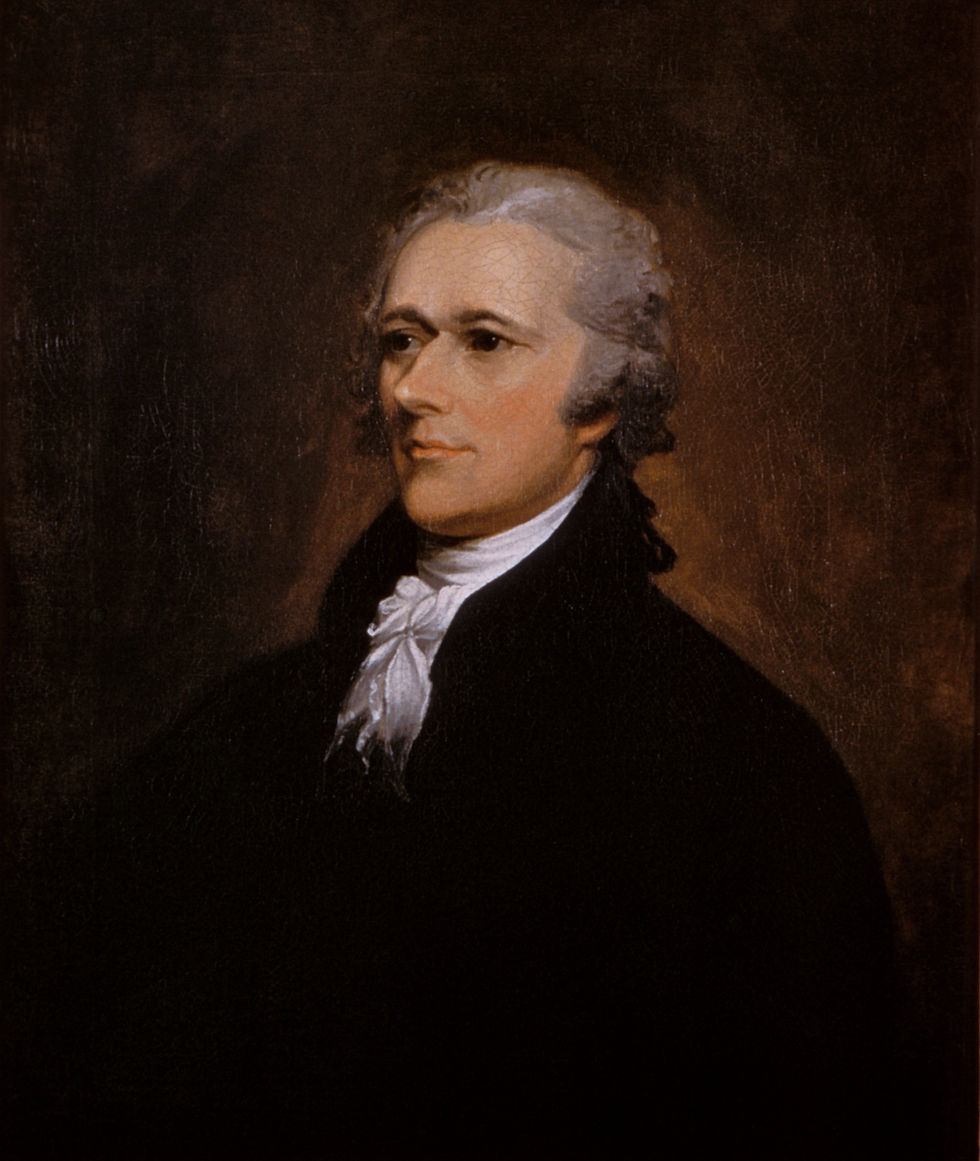
History doesn’t always whisper, sometimes it argues, writes obsessively, fights duels, and builds nations from ink and audacity. Alexander Hamilton was not born into power; he stormed it. An immigrant with relentless ambition, he carved his name into the earliest foundations of the United States, transforming ideas into institutions that still shape modern economics and governance. His story feels almost cinematic: a young outsider arriving with little more than intellect and urgency, determined to prove that origin does not define destiny.
From an academic lens, Hamilton represents a crucial figure in the development of federal authority and economic infrastructure in the late 18th century.
As the first Secretary of the Treasury, he designed fiscal systems that stabilized a fragile new republic, advocating for centralized banking, federal assumption of state debts, and policies that encouraged industrial growth. His contributions were not merely administrative, they were ideological, helping define debates about constitutional interpretation, economic direction, and the balance of political power.
Hamilton’s life invites both narrative intrigue and scholarly examination: a paradox of idealism and pragmatism, controversy and vision. To understand him is to explore the tension between revolutionary freedom and structured order, a tension that continues to echo through modern political and economic thought.
Content Table
Early Life: From the West Indies to New York
Before Alexander Hamilton ever shaped the financial architecture of a nation, he was a boy surrounded by the restless tides of the Caribbean, a world defined by sugar empires, maritime trade, and rigid social hierarchies. Born on the island of Nevis (likely in 1755 or 1757) and raised on St. Croix, Hamilton’s earliest environment exposed him to both opportunity and precarity. The Caribbean in the mid-18th century was not merely a tropical backdrop; it was a crucible of imperial commerce where European powers extracted immense wealth through plantation economies and enslaved labor. Hamilton’s childhood unfolded at the intersection of these forces, where ships carried fortunes across the Atlantic while leaving inequality deeply entrenched in colonial society.
His family life reflected this instability. His parents’ unmarried status placed Hamilton outside the boundaries of legal legitimacy, a condition that limited inheritance rights and social mobility. When his father, James Hamilton, abandoned the household and his mother, Rachel Faucette, died of illness in 1768, Hamilton and his brother were left effectively orphaned. Economic necessity compelled him into employment as a clerk at Beekman and Cruger, a trading firm whose correspondence exposed him to international markets, credit systems, and the language of mercantile ambition. Even as an adolescent, Hamilton demonstrated unusual intellectual agility, drafting business letters, managing accounts, and understanding the fragile interdependence of colonial economies.
A pivotal moment arrived in 1772 when a catastrophic hurricane devastated St. Croix. Hamilton’s detailed narrative of the storm, published in a local newspaper, revealed striking descriptive power and analytical clarity. The essay blended emotional intensity with structured argument, capturing both the physical violence of the hurricane and the existential vulnerability of colonial life. Community leaders, recognizing rare talent, raised funds to send him to North America for formal education. His relocation to New York in 1773 marked the beginning of a profound transformation: from peripheral colonial subject to emerging political thinker.
In New York, Hamilton entered an intellectual environment shaped by Enlightenment philosophy and intensifying resistance to British authority. He studied at King’s College (now Columbia University), immersing himself in classical literature, political theory, and debates concerning sovereignty and rights. The city itself, alive with pamphlets, protests, and ideological experimentation, offered Hamilton both an audience and a purpose. His Caribbean experiences had already acquainted him with economic volatility and imperial power structures; New York provided the forum in which those observations matured into political conviction.
Hamilton’s early life reveals the paradox of marginality as preparation for influence. Hardship cultivated resilience, exposure to commerce fostered analytical discipline, and displacement encouraged adaptive ambition. The journey from the West Indies to New York did more than alter his circumstances, it forged a worldview shaped by urgency, meritocratic belief, and a conviction that structural systems could transform individual destinies. These formative experiences would later inform his advocacy for strong institutions capable of stabilizing a young republic, demonstrating how personal adversity can evolve into public vision.
Family and Personal Life

Beyond his public brilliance, Alexander Hamilton navigated a rich, complicated personal life, centered around his wife, children, and domestic commitments. In 1780, Hamilton married Elizabeth Schuyler Hamilton, daughter of the wealthy and influential Schuyler family of Albany, New York. Elizabeth, often referred to as Eliza, became a stabilizing force in Hamilton’s tumultuous life, offering emotional support during the Revolutionary War, the political battles of the 1790s, and even the scandalous turbulence of the Reynolds affair. Their union was both strategic and deeply personal, merging social prominence with intellectual companionship.
The couple had eight children: Philip, Angelica, Alexander Jr., James Alexander, John Church, William Stephen, Eliza, and another son who died in infancy. Hamilton’s dedication to his children reflected his belief in education, discipline, and ambition. Tragically, the family endured immense sorrow; his eldest son, Philip, was killed in a duel in 1801 at just 19, a loss that profoundly affected Hamilton and presaged the fatal duel with Aaron Burr three years later. Despite personal tragedies, Hamilton’s letters and correspondence reveal a father who was intellectually engaged, affectionate, and invested in shaping his children’s futures.
Elizabeth outlived Hamilton by fifty years, dedicating her life to preserving his memory and advancing social causes, particularly the founding of the Orphan Asylum Society in New York City. She became a guardian not only of Hamilton’s legacy but also of his extended family, raising their grandchildren and ensuring that the Hamilton name remained influential in social and political spheres.
Hamilton’s family life was inseparable from his identity: his marriage to Eliza provided emotional grounding amid public chaos, and his children offered both joy and heartbreak that shaped his decisions and ambitions. The household reflected the tensions of early America itself, a mix of high expectations, public scrutiny, and the relentless pursuit of legacy, intertwining personal love with the broader narrative of nation-building.
The Revolutionary War
The American Revolutionary War was not only a conflict between colonies and empire; it was a crucible in which Alexander Hamilton transformed from ambitious intellectual into indispensable military strategist. Fought primarily between the Kingdom of Great Britain and thirteen American colonies that would become the United States, the war expanded into a global struggle involving France, Spain, and the Dutch Republic, each seeking to weaken British dominance. Within this geopolitical storm, Hamilton’s rise was remarkably swift.
When conflict erupted at the Battles of Lexington and Concord, Hamilton was still a student, yet the ideological urgency of colonial resistance drew him toward active participation. He joined a New York militia unit, later becoming captain of an artillery company distinguished for discipline and technical precision. Artillery demanded mathematical competence and composure under pressure, qualities Hamilton possessed in unusual measure. His performance during the Battle of Long Island and subsequent defensive operations around New York drew the attention of senior leadership.
In 1777, Hamilton’s trajectory changed decisively when he was appointed aide-de-camp to George Washington, commander-in-chief of the Continental Army. This role placed him at the strategic core of the revolutionary effort. Acting as Washington’s principal secretary and confidential advisor, Hamilton drafted critical correspondence, translated battlefield developments into strategic recommendations, and helped coordinate communication between generals, Congress, and foreign allies. His pen became as essential as any weapon, shaping diplomatic language that secured vital French support following the Battle of Saratoga, a turning point that persuaded France to formally ally with the American cause.
Hamilton’s proximity to Washington also immersed him in the practical difficulties of sustaining a revolutionary army: chronic shortages of supplies, tensions between civilian authority and military necessity, and the challenge of unifying diverse colonial interests. Exposure to these structural weaknesses profoundly influenced Hamilton’s later advocacy for centralized governance. He witnessed firsthand how fragile coordination could jeopardize independence, reinforcing his belief that effective institutions were as crucial as battlefield victories.
Despite the prestige of staff service, Hamilton longed for independent command, fearing that excessive administrative work would limit his military reputation. In 1781, after persistent requests, Washington granted him leadership of a light infantry battalion during the climactic Siege of Yorktown. There, Hamilton commanded a decisive nighttime assault on British fortifications, capturing Redoubt No. 10 with minimal casualties. The operation demonstrated tactical boldness balanced by disciplined restraint, enhancing his reputation as both strategist and combat leader. Yorktown effectively ended major hostilities, confirming the viability of American independence.
Hamilton’s wartime experience was not merely formative; it was transformative. The Revolutionary War provided him with direct exposure to international diplomacy, coalition warfare, and administrative complexity. He observed the interconnected roles of military organization, fiscal stability, and political legitimacy, insights that later informed his design of national financial systems. Serving as Washington’s trusted intermediary also allowed Hamilton to cultivate relationships within emerging political networks, positioning him among the most influential voices in shaping the postwar republic.
Through intellect, adaptability, and relentless work ethic, Hamilton evolved from outsider to insider, proving that strategic thought could elevate an individual as effectively as battlefield heroism. His Revolutionary War service reveals the fusion of theory and action: a young immigrant translating Enlightenment ideals into institutional realities while helping secure independence for a nation still in conceptual formation.
Architect of American Finance
When the American Revolutionary War ended, the newly formed United States faced a quieter but equally dangerous battlefield: economic collapse. The young republic was drowning in debt, its currency unstable, its credit nearly nonexistent, and its political future uncertain. Into this fragile moment stepped Alexander Hamilton, appointed by George Washington in 1789 as the nation’s first Secretary of the Treasury. Hamilton did not simply manage finances, he engineered the economic nervous system of a country still learning how to breathe.
Hamilton believed financial stability was essential for political survival. Influenced by European fiscal models, particularly those of the Kingdom of Great Britain, he envisioned a structured national economy capable of supporting industry, commerce, and governmental authority. In his Report on Public Credit (1790), Hamilton proposed that the federal government assume the debts accumulated by individual states during the Revolution. This controversial measure aimed to unify the states economically and bind them to the federal system through shared financial responsibility. By transforming scattered obligations into consolidated national debt, Hamilton strengthened both domestic confidence and international credibility.
Equally transformative was Hamilton’s advocacy for a central banking institution. His proposal led to the creation of the First Bank of the United States, designed to regulate currency, manage government funds, and provide loans that would stimulate economic growth. Hamilton argued that credit, when responsibly structured, could function as a productive force rather than a liability. His interpretation of the United States Constitution emphasized implied powers, asserting that federal authority could expand when necessary to ensure national stability. This constitutional reasoning provoked opposition from figures like Thomas Jefferson, who feared centralized power might threaten republican liberty.
Hamilton also promoted tariffs and manufacturing incentives in his Report on Manufactures (1791), seeking to reduce dependence on foreign imports and cultivate domestic industry. His economic philosophy recognized the interconnected relationship between production, trade, and sovereignty. For Hamilton, economic independence was inseparable from political independence; a nation unable to finance itself could not fully govern itself.
Through policy design, persuasive writing, and institutional innovation, Hamilton converted theoretical frameworks into functioning systems. His financial program stabilized the national economy, established long-term creditworthiness, and encouraged investment that accelerated commercial expansion. Though controversial in his own era, many elements of Hamilton’s economic vision continue to influence modern fiscal policy, central banking practices, and debates about federal authority.
Hamilton’s tenure as Secretary of the Treasury illustrates the transformative power of structured ambition. He understood that revolutions are not secured by victory alone, they endure through systems capable of managing complexity, risk, and growth. By constructing financial institutions that balanced flexibility with discipline, Hamilton helped ensure that the United States would not merely exist, but persist.
The Federalist Papers and Political Philosophy
In the turbulent aftermath of independence, the future of the United States remained uncertain. The fragile union created under the Articles of Confederation had revealed deep structural weaknesses: limited federal authority, financial instability, and political fragmentation among the states. Into this ideological crossroads stepped Alexander Hamilton, determined to shape not only the machinery of government but the philosophy guiding its operation. His most enduring intellectual contribution emerged through the The Federalist Papers, a collection of essays advocating for ratification of the United States Constitution.
Written collaboratively with James Madison and John Jay, the essays were originally published anonymously under the pseudonym Publius. Hamilton authored the majority of the 85 essays, demonstrating both intellectual stamina and ideological urgency. His writings framed the Constitution not as a departure from republican principles, but as their necessary evolution. He argued that liberty required structure, that freedom without institutional stability risked dissolving into factional conflict and economic vulnerability.
Hamilton’s political philosophy emphasized energetic government capable of maintaining order, regulating commerce, and preserving national unity. In Federalist No. 1, he presented the ratification debate as a historic test of whether societies could establish government through reason rather than accident or force. In Federalist No. 70, he defended the necessity of a strong executive, asserting that decisive leadership promotes accountability and efficiency. Meanwhile, Federalist No. 78 articulated the importance of an independent judiciary capable of interpreting laws without political pressure, reinforcing constitutional balance.
Central to Hamilton’s thought was a pragmatic understanding of human nature. He did not assume political actors would behave virtuously; rather, he designed arguments acknowledging ambition, self-interest, and competing loyalties. His support for checks and balances reflected a belief that power should be structured to regulate itself. Rather than fearing authority outright, Hamilton feared disorganization, convinced that weak governance could invite instability or foreign influence.
The Federalist essays were not purely theoretical; they were strategic interventions in a public debate that would determine the nation’s future. Through persuasive rhetoric, historical references, and analytical reasoning, Hamilton helped shift public opinion toward ratification, ultimately contributing to the Constitution’s adoption in 1788. His vision promoted unity through complexity, advocating a system flexible enough to evolve yet stable enough to endure.
Hamilton’s political philosophy reveals a thinker deeply concerned with sustainability of republican government in an unpredictable world. His arguments continue to inform constitutional interpretation, debates regarding executive authority, and broader discussions about the relationship between liberty and institutional power. Through The Federalist Papers, Hamilton did not merely comment on political theory, he actively shaped the intellectual architecture of modern democratic governance.
The Reynolds Pamphlet: America’s First Political Sex Scandal
By the 1790s, Alexander Hamilton had already secured a formidable reputation as the chief architect of the young United States financial system. Yet in 1797, his public image faced an unprecedented challenge when a deeply personal controversy erupted into political spectacle. The episode culminated in the publication of the Reynolds Pamphlet, a confessional text in which Hamilton openly admitted to an extramarital affair, a shocking and unusual act of self-disclosure in early American political culture.
The scandal originated in 1791 when Maria Reynolds approached Hamilton requesting financial assistance, claiming abandonment by her husband, James Reynolds. Hamilton later acknowledged that the encounter developed into a secret relationship, during which James Reynolds allegedly exploited the situation through blackmail. Payments made by Hamilton to Reynolds created the appearance of financial misconduct, providing political rivals with material to accuse him of corruption during his tenure as Secretary of the Treasury.
Opponents, including allies of Thomas Jefferson, suspected that the financial transactions indicated misuse of public funds. Determined to defend his professional integrity, Hamilton chose a radical course: he published a detailed public statement explaining the affair and denying any involvement in financial fraud. The pamphlet included personal letters and chronological explanations intended to demonstrate that the payments were connected to private coercion rather than public corruption.
While the publication succeeded in protecting Hamilton from accusations of financial impropriety, it irreparably damaged his personal reputation. The episode is often described as the first major political sex scandal in American history, illustrating how emerging partisan rivalries increasingly weaponized private conduct for public advantage. Hamilton’s decision to disclose the affair reflected both his prioritization of political credibility and his belief that transparency could neutralize suspicion regarding his fiscal policies.
The Reynolds controversy reveals the growing intensity of early American political culture, where ideological disagreement frequently merged with personal rivalry. It also demonstrates Hamilton’s characteristic directness: confronted with allegations threatening his public legacy, he chose disclosure over silence, sacrificing personal dignity to preserve institutional trust. The scandal remains a striking example of how private choices can reverberate through public life, shaping both historical memory and political discourse.
The Final Duel: Hamilton vs. Burr
The rivalry between Alexander Hamilton and Aaron Burr was not born in a single moment of anger, but cultivated over years of political tension, ideological disagreement, and personal mistrust. By the early 19th century, both men stood as prominent yet polarizing figures within the evolving political landscape of the United States. Their conflict reached its tragic conclusion in the Burr vs. Hamilton duel, fought on July 11, 1804, in Weehawken, a location already associated with earlier duels due to its relative legal leniency compared to nearby New York.
Political competition intensified after the contentious United States presidential election of 1800AD, in which Burr and Thomas Jefferson received an equal number of electoral votes. Hamilton, despite deep ideological differences with Jefferson, viewed Burr as dangerously unprincipled and used his influence to support Jefferson’s eventual victory in the House of Representatives. This intervention contributed to Burr’s growing resentment. By 1804, when Burr sought the governorship of New York, Hamilton reportedly expressed harsh criticisms regarding Burr’s character, remarks that circulated through political networks and reached Burr himself.
Interpreting Hamilton’s comments as an attack on his honor, Burr issued a formal challenge in accordance with the dueling code practiced among elite men of the era. Though dueling was illegal, it remained culturally embedded as a ritualized method of defending personal reputation. Hamilton, aware of the potential consequences yet unwilling to appear cowardly, accepted the challenge while privately expressing moral reservations. Some historical interpretations suggest that Hamilton intended to deliberately miss his shot (a practice known as “throwing away” the fire) in hopes of preserving honor without taking a life.
At dawn on the dueling grounds overlooking the Hudson River, the two men faced each other with pistols at a measured distance. Accounts differ regarding the precise sequence of events, but Burr’s shot struck Hamilton in the abdomen, inflicting a mortal wound. Hamilton was transported across the river to New York City, where he died the following day, July 12, 1804. His death shocked the nation, provoking widespread public mourning and intense criticism of Burr, whose political career never fully recovered.
The duel symbolized more than a personal feud; it reflected the volatile intersection of pride, political rivalry, and evolving cultural norms in the early republic. Hamilton’s death deprived the nation of one of its most influential institutional thinkers, while Burr’s legacy became permanently shadowed by the event. The tragedy at Weehawken illustrates the fragile boundary between public ambition and private honor, demonstrating how deeply personal conflicts could alter the trajectory of national leadership.
Hamilton’s final chapter reinforces the complexity of his character: fiercely principled, deeply ambitious, and ultimately vulnerable to the same codes of honor he intellectually questioned. His death marked the end of a life defined by relentless drive to shape systems larger than himself, leaving behind a legacy that continued to influence American political and economic thought long after the echo of gunfire faded.
Legacy: How Alexander Hamilton Shaped Modern America
The enduring influence of Alexander Hamilton extends far beyond the 18th century, continuing to shape the institutional, economic, and constitutional framework of the United States. Few founders left behind a legacy as structurally embedded in daily governance. Hamilton’s vision of a dynamic, economically resilient nation helped define how modern states balance authority, markets, and public trust. His ideas did not merely survive political opposition, they became foundational assumptions within American political economy.
Hamilton’s financial architecture established the credibility necessary for national growth.
Through the creation of structured public credit, centralized banking systems such as the First Bank of the United States, and federal management of Revolutionary War debt, he positioned the United States as a stable participant in global trade networks. His belief that a nation’s strength depended on productive industry anticipated the expansion of manufacturing throughout the 19th century, influencing policies that encouraged infrastructure, investment, and technological innovation. Modern institutions such as the Federal Reserve System reflect principles Hamilton championed: regulated currency supply, financial oversight, and mechanisms designed to prevent economic collapse.
Equally significant was Hamilton’s constitutional philosophy. Through the The Federalist Papers, he articulated an argument for adaptive governance grounded in the doctrine of implied powers, allowing federal authority to respond flexibly to emerging national challenges. His interpretation helped legitimize the expansion of executive and legislative capabilities in areas such as economic regulation, defense coordination, and interstate commerce. The durability of the United States Constitution owes much to this intellectual elasticity, enabling reinterpretation without abandonment of foundational principles.
Hamilton’s influence also persists culturally. His life story (an immigrant rising through intellect, discipline, and strategic insight) has become emblematic of aspirational narratives within American identity. Renewed popular interest emerged through the cultural impact of Hamilton by Lin-Manuel Miranda, which reintroduced his story to contemporary audiences and stimulated public engagement with early American history.
Yet Hamilton’s legacy remains complex. Critics have argued that his preference for strong centralized authority risked concentrating power among economic elites, raising enduring questions regarding democratic representation and financial influence. These debates demonstrate the continued relevance of Hamilton’s ideas in modern political discourse. Discussions surrounding federal authority, banking regulation, and national economic strategy often echo tensions first articulated in the 1790s.
Hamilton ultimately helped transform a fragile post-revolutionary coalition into a functioning nation capable of long-term development. His contributions illustrate how durable systems often emerge from contested ideas, careful design, and willingness to challenge prevailing assumptions. Modern America (its financial markets, constitutional interpretation, and administrative structures) still carries the imprint of Hamilton’s determination to build stability from uncertainty.
The Museum of Time Team
4 April 2026


Comments