Ancient Trade Networks of Australia: Indigenous Routes, Paths, and Cultural Exchange

Australia’s ancient trade networks were never empty lines across a silent desert. Long before European ships cut through the Indian Ocean, Aboriginal peoples built vast systems of exchange that connected coasts, rainforests, deserts, and riverlands across the continent. Stone axes travelled hundreds of kilometers. Ochre moved from sacred quarries into ceremonies far away. Shells from northern shores appeared deep inland, carried through generations of trade, diplomacy, and storytelling. These networks were not simply about goods, they carried songs, law, spiritual knowledge, alliances, and survival itself.
Across thousands of years, trade routes threaded through Australia like living veins, guided by songlines and deep environmental knowledge. Communities exchanged resources according to seasonal movement, kinship obligations, and ceremonial gatherings, creating one of the oldest continuous systems of cultural connection in human history. Far from isolated, Aboriginal societies maintained sophisticated economies shaped by geography, trust, and memory. Understanding these trade systems challenges outdated ideas about pre-colonial Australia and reveals a continent alive with movement, negotiation, and cultural richness long before modern borders existed.
Content Table
The Mechanics of Traditional Aboriginal Trade
Traditional Aboriginal trade systems operated without coins, markets, or formal currency, yet they supported one of the oldest continuous exchange networks in human history. Across deserts, river systems, tropical coasts, and mountain ranges, Aboriginal communities developed intricate systems of barter built on reciprocity, kinship, and cultural responsibility. Goods were exchanged not according to fixed prices, but according to need, trust, spiritual significance, and social obligation. In many ways, wealth was measured less by accumulation and more by the strength of relationships maintained through exchange.
Trade routes stretched across astonishing distances. Ochre from sacred quarry sites travelled hundreds, sometimes thousands, of kilometers for use in ceremonies and body painting. Pearl shells from the northern coasts moved deep into the desert interior, where they became symbols of status and spiritual importance. Stone axe heads crafted from prized greenstone quarries circulated widely between communities, prized for their durability and craftsmanship. Along these routes moved not only objects, but also stories, songs, technologies, medicinal knowledge, and law. Every exchange strengthened social ties between groups and reinforced a continent-wide web of connection long before European arrival.
Unlike modern commercial systems driven by profit, Aboriginal trade depended heavily on mutual respect and long-term relationships. Exchanges were often accompanied by hospitality, ritual obligations, and shared ceremonies. Refusing trade or breaking trust could damage alliances that communities relied upon for survival during droughts, seasonal migrations, or conflict. Trade therefore became deeply tied to diplomacy and social stability. The act of giving itself carried meaning, creating obligations that might be repaid months or even years later through another exchange or act of assistance.
Safe travel between territories required careful negotiation because each Aboriginal nation maintained strong connections to its own Country. Travellers moving through unfamiliar land needed permission and recognition from local groups. One important instrument used in this process was the message stick, sometimes known in several regions as bulla. These carved wooden objects functioned as symbolic passports and communication tools, carrying invitations, announcements, ceremonial requests, or trade intentions between communities. The markings on the sticks varied across language groups, but their purpose remained clear: they identified the bearer as someone travelling under recognized authority and peaceful intent.
Message sticks reveal the sophistication of Aboriginal communication systems. In a society where oral tradition preserved law, genealogy, and history, the stick acted as a physical extension of spoken authority. A messenger carrying one could cross significant distances between nations, delivering information that connected communities spread across the continent. These systems helped maintain stability across trade routes that had existed for countless generations.
At certain times of the year, trade expanded into enormous ceremonial gatherings that resembled temporary macro-market hubs. Communities travelled from distant regions to attend events where economic exchange blended seamlessly with spirituality, diplomacy, performance, and celebration. One of the most famous examples emerged around the greenstone quarries of southeastern Australia, where valuable stone used for axe heads attracted traders from across wide territories. Camps could grow into vast meeting grounds filled with negotiation, storytelling, dancing, feasting, and ritual activity.
These gatherings served many purposes beyond commerce. Marriages were arranged, disputes settled, alliances renewed, and sacred knowledge passed between generations. Songs and dances carried histories of trade routes and relationships, embedding geography into cultural memory through oral tradition. The atmosphere was not simply transactional; it was deeply communal and ceremonial. Trade was woven into identity itself, linking people to each other and to the land they travelled across.
Rather than isolated societies scattered across an empty continent, Aboriginal nations formed a dynamic network of movement and exchange that connected Australia for thousands of years. The mechanics of traditional trade reveal a sophisticated system shaped by environmental knowledge, diplomacy, spirituality, and cooperation, a system whose complexity is only beginning to receive the recognition it deserves today.
Key Commodities Exchanged Across the Continent
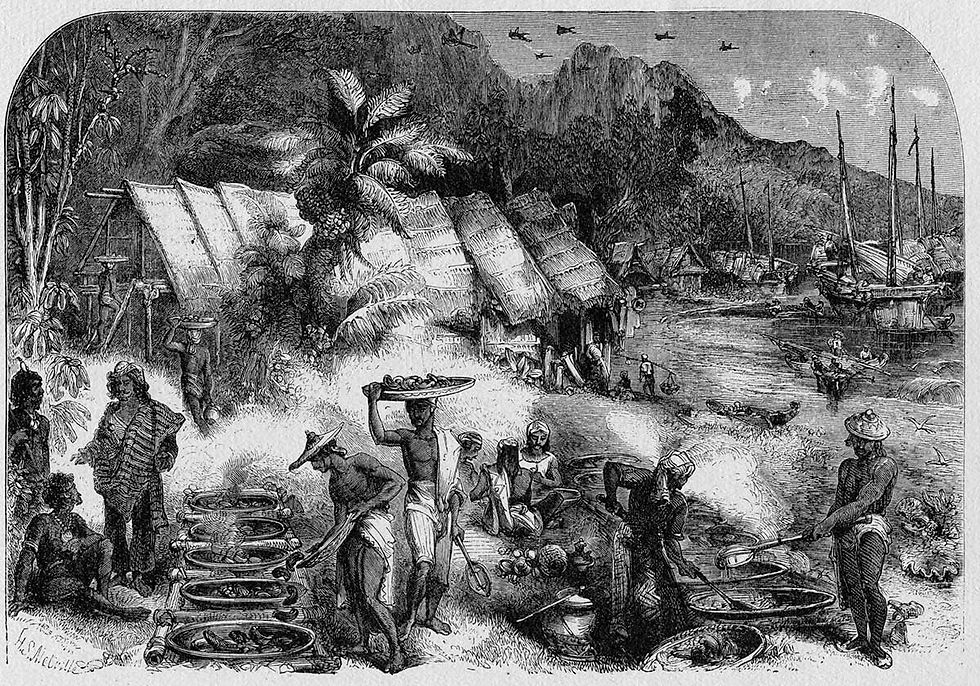
The trade routes that crossed ancient Australia were carried by more than footsteps alone. Moving steadily between coasts, deserts, forests, and riverlands were objects of immense practical, spiritual, and social value. Some commodities were essential tools for survival, while others held ceremonial power that connected communities to ancestral law and identity. Over centuries, these goods travelled astonishing distances through carefully maintained exchange networks, revealing just how interconnected Aboriginal Australia truly was.
Among the most significant commodities traded across inland Australia was pituri, a native stimulant derived from several plant species found mainly in the arid interior of central Australia. Often described as a form of ancient Australian tobacco, pituri was highly valued for its stimulating and medicinal effects. Aboriginal communities chewed the leaves mixed with ash, creating a substance that reduced hunger, increased endurance, and helped travellers endure long journeys across harsh desert landscapes. In a continent where survival often depended on movement through extreme environments, pituri became both a practical resource and a prized trade item.
The demand for pituri created extensive exchange routes stretching across central Australia. Communities who controlled access to pituri-producing regions held considerable economic and diplomatic influence. Traders carried the stimulant vast distances, exchanging it for stone tools, ochre, weapons, ceremonial objects, and other valuable goods. Early European observers were astonished by the scale of these networks, noting that pituri could travel hundreds of kilometers through multiple communities before reaching its destination. More importantly, the trade reflected a deep understanding of ecological resources and regional specialization long before modern economic systems emerged on the continent.
Equally important was ochre, one of the most sacred and widely distributed materials in Aboriginal Australia. Red and yellow ochre were not simply pigments for decoration; they carried spiritual significance tied to ceremony, storytelling, burial practices, and identity. Mixed with fats or water, ochre was used in rock art, body painting, initiation rituals, and sacred performances that connected people to ancestral beings and Dreaming traditions. Different regions became known for producing ochre of exceptional quality, turning quarry sites into major centers of exchange.
Some ochre quarries held such importance that access was controlled through strict cultural protocols. The famous ochre pits of central and southern Australia supplied pigment that travelled across enormous distances through trade partnerships maintained over generations. The color itself often carried symbolic meaning, red ochre could represent blood, life, ancestral power, or connection to Country, while yellow ochre frequently symbolized the earth, sunlight, or spiritual transformation. Because of these meanings, ochre possessed value far beyond material usefulness. Transporting it across the continent also meant carrying ceremony, law, and sacred identity from one community to another.
Marine shells formed another major component of long-distance trade, particularly bailer shells and pearl shells harvested from northern coastal regions such as the Kimberley and the Gulf of Carpentaria. These shells moved deep into the inland desert, reaching communities who may never have seen the ocean itself. Their physical beauty made them highly prized, but their value extended into ritual and symbolic life as well. Pearl shells, with their shimmering surfaces, were often transformed into pendants and ceremonial ornaments associated with rainmaking, fertility, and status.
The movement of shells across Australia reveals the extraordinary reach of Aboriginal trade systems. Archaeological evidence shows coastal materials appearing thousands of kilometers inland, passed carefully between groups through established exchange routes. The shells also carried stories of distant places, linking desert communities symbolically to northern seas and reinforcing the idea that trade connected vastly different environments into a shared cultural network. In many ceremonies, these objects represented not only wealth, but relationships between people, landscapes, and ancestral forces.
Stone tools perhaps best demonstrate the technical sophistication of Aboriginal trade economies. High-quality stone suitable for toolmaking was unevenly distributed across the continent, meaning communities often specialized in quarrying and crafting particular materials. Greenstone, prized for its toughness and ability to produce durable axe heads, became one of the most sought-after resources in southeastern Australia. Axe heads manufactured near major quarry sites circulated across immense distances, exchanged repeatedly between communities along established routes.
Silcrete and other tool stones were also traded widely for the production of blades, spear points, scrapers, and cutting implements. Skilled artisans shaped these materials with remarkable precision, producing tools suited to hunting, woodworking, food preparation, and ceremonial use. Some quarry sites operated almost like industrial centers, where large-scale extraction and production supported broad regional exchange systems. The distribution of stone tools demonstrates that Aboriginal economies involved specialization, resource management, and coordinated networks far more complex than older colonial narratives once admitted.
What makes these commodities especially remarkable is that they rarely travelled alone. A shipment of ochre might move alongside songs and ceremonial obligations. Pituri exchanges could strengthen political alliances between distant groups. A pearl shell pendant might carry both spiritual significance and the memory of multiple communities through which it had passed. In Aboriginal Australia, trade was never purely economic. Objects gathered meaning through movement, relationship, and story.
Together, commodities such as pituri, ochre, marine shells, and stone tools reveal a continent alive with circulation long before European settlement. These exchange systems connected environments as different as tropical coastlines and desert interiors into one vast cultural landscape. Far from isolated societies, Aboriginal nations participated in sophisticated networks of commerce, diplomacy, and ceremonial exchange that endured for thousands of years and formed one of the foundational structures of life across ancient Australia.
Major Ancient Trade Routes and Pathways
Ancient Australia was crossed by an immense web of pathways that connected distant communities across deserts, grasslands, mountain ranges, river systems, and coastlines. These were not roads in the modern sense, carved into the earth with stone or concrete, but living routes remembered through oral tradition, ceremony, environmental knowledge, and repeated movement over countless generations. Songlines, seasonal travel corridors, river systems, and trading paths linked Aboriginal nations into one of the oldest continuously operating exchange networks in human history. Along these routes travelled goods, but also law, spirituality, stories, languages, technologies, and diplomacy.
Among the most remarkable of these pathways was the vast north-south trading corridor stretching from the Gulf of Carpentaria in northern Australia toward the Southern Ocean. This route connected tropical coastal communities with the arid interior and eventually with southern peoples thousands of kilometers away. Through chains of exchange rather than single uninterrupted journeys, goods could travel extraordinary distances across the continent.
From the north came marine products such as pearl shells, bailer shells, and prized coastal materials that gradually moved inland through successive trade partnerships. In return, desert communities contributed pituri, ochre, stone tools, and ceremonial knowledge. The route also facilitated the movement of songs, dances, and ritual practices between widely separated nations, creating cultural continuity across enormous geographic space. What modern maps often portray as isolated environments were, in reality, deeply interconnected worlds linked by memory and movement.
Travelling these routes required intimate environmental knowledge. Traders navigated according to waterholes, stars, seasonal changes, and sacred landmarks embedded within oral tradition. Knowledge of Country was essential because survival depended on understanding where food, water, and safe passage could be found across difficult terrain. These journeys could take weeks or months, with travellers moving carefully through territories governed by strict cultural protocols and reciprocal relationships.
The river systems of southeastern Australia formed another major artery of exchange, particularly within the Murray-Darling Basin. The rivers acted as natural highways through some of the continent’s most fertile and densely populated regions. Communities settled along the Murray, Darling, and their tributaries developed strong economic and ceremonial connections, allowing goods and ideas to move efficiently across vast distances.
Fish, woven nets, stone tools, ochre, possum-skin cloaks, and plant resources circulated through riverine trade systems that followed seasonal gatherings and ecological cycles. The abundance of water and food resources supported large ceremonial meetings where exchange intensified. River crossings and campsites became important social and diplomatic centers, facilitating communication between numerous Aboriginal nations across southeastern Australia.
The Murray-Darling networks were also culturally significant because rivers themselves held deep spiritual meaning. Trade routes often followed pathways already embedded in Dreaming stories, connecting economic movement with sacred geography. In this sense, travelling a trade route was not simply practical transportation; it was participation in a living cultural landscape shaped by ancestral memory.
Equally extraordinary were the trade pathways connecting Australia’s coastlines with its remote desert interior. Some of the continent’s most valuable commodities travelled along these routes over distances that continue to astonish archaeologists and historians today. Marine shells harvested along northern and western coasts appeared deep within central desert communities far removed from the sea. Likewise, red ochre mined in inland quarry sites reached coastal ceremonial centers hundreds or even thousands of kilometers away.
These coastal-to-desert exchanges demonstrate the scale and sophistication of Aboriginal trade systems. Goods moved gradually through interconnected regional partnerships rather than through a single centralized market. One community might exchange shells with a neighboring group, who then traded them further inland, continuing the process across multiple territories. Over time, objects could cross nearly the entire continent while accumulating social and ceremonial significance through each exchange.
Trade routes also adapted to Australia’s environmental diversity. In wetter regions, rivers and seasonal pathways supported easier movement, while desert routes relied heavily on detailed knowledge of scarce water sources and climatic conditions. Seasonal timing mattered enormously. Travellers often planned journeys around ceremonies, rainfall patterns, animal migrations, or periods of resource abundance. This flexibility allowed trade networks to endure despite the harshness of many Australian environments.
Importantly, these pathways were not solely economic systems. Every route existed within a framework of kinship, law, and spirituality. Songlines often functioned as both navigational systems and sacred narratives, encoding geographical information within stories, music, and ceremony. A traveller following a songline was not merely moving through space; they were retracing the journeys of ancestral beings whose actions shaped the land itself. Trade therefore became inseparable from cultural identity and spiritual obligation.
The sophistication of these networks challenges older colonial assumptions that pre-colonial Australia lacked large-scale organization or economic complexity. Long before European settlement, Aboriginal nations had already developed efficient systems capable of transporting goods, maintaining alliances, and connecting distant regions across one of the world’s harshest continents. Ancient Australian trade routes reveal a civilization built not upon permanent roads or written maps, but upon memory, reciprocity, environmental mastery, and enduring human connection.
International Connections: Macassan Contact and Northern Trade

Long before British colonization began in 1788, the northern coastlines of Australia were already connected to international networks of trade and maritime exchange. For centuries, Aboriginal communities in northern Australia maintained contact with seafaring visitors from Southeast Asia, particularly the Macassans from present-day Indonesia. These interactions challenge the long-standing colonial myth that Australia existed in total isolation before European arrival. In reality, parts of the continent were linked to regional economies, cultural exchange systems, and maritime trade routes that stretched across the waters of the Indonesian archipelago and beyond.
Among the most significant examples of this international connection was the relationship between the Yolngu people of Arnhem Land and Macassan trepang traders. Trepang, also known as sea cucumber, was highly valued in Chinese markets as a luxury food and medicinal product. Beginning at least several centuries before European settlement (and possibly earlier) fleets of Macassan sailors travelled seasonally from Sulawesi to the northern coast of Australia during the monsoon winds to harvest trepang from shallow coastal waters.
The trade became a major economic enterprise. Macassan crews established temporary processing camps along the Arnhem Land coastline, where trepang was boiled, smoked, dried, and prepared for export through Southeast Asian trade networks into China. Yolngu communities played an important role in this process, assisting with harvesting, gathering firewood, supplying water, navigating local environments, and participating in exchange relationships that developed over generations.
Unlike the violent dispossession that later accompanied European colonization, Macassan contact appears to have operated largely through negotiated relationships and mutual benefit, although power dynamics and conflicts undoubtedly existed at times. Archaeological evidence, oral histories, and linguistic records all suggest sustained interaction between Yolngu peoples and Macassan traders over long periods. These encounters left deep marks on northern Aboriginal societies, shaping aspects of culture, economy, and identity.
One of the clearest legacies of this connection can be seen in the technological and linguistic exchanges that emerged through contact with Southeast Asia. Macassan visitors introduced metal tools, dugout canoes, cloth, tobacco, fishing technologies, and new forms of material culture into northern Australia. Metal axes and knives, in particular, transformed certain aspects of daily life because they proved more durable and efficient than many traditional stone tools.
Maritime technology also evolved through this contact. Yolngu communities adapted and incorporated dugout canoe designs that improved long-distance sea travel and fishing capabilities along northern coasts and islands. These innovations strengthened already sophisticated Indigenous maritime traditions and expanded opportunities for movement, fishing, and regional trade.
Language provides another powerful reminder of these centuries of interaction. Numerous Macassan words entered Yolngu languages, particularly terms connected to trade, sailing, smoking tobacco, and introduced technologies. Some Aboriginal groups even developed partial familiarity with Macassan languages for communication during trading seasons. Songs, ceremonies, and oral histories preserved memories of these encounters, embedding international exchange directly into the cultural traditions of northern Australia.
The influence also moved in multiple directions. Macassan traders depended heavily on Aboriginal environmental knowledge to navigate unfamiliar coastlines, locate resources, and survive seasonal conditions. Aboriginal labor, guidance, and cooperation became essential to the success of the trepang industry along Australia’s northern shores. These relationships reveal that Indigenous communities were active participants in regional commerce rather than passive observers of foreign contact.
Further east, the Torres Strait formed another major center of pre-European maritime commerce. Far from acting as a barrier between Australia and Papua New Guinea, the strait functioned as a dynamic cultural and trading zone linking island communities across the region. Torres Strait Islanders developed advanced seafaring traditions and maintained extensive exchange systems that connected northern Australia with Melanesian societies to the north.
Trade across the Torres Strait included goods such as shells, ceremonial objects, canoes, tools, weapons, and food resources. Canoe voyages between islands and coastal communities facilitated not only economic exchange but also intermarriage, diplomacy, ritual cooperation, and cultural transmission. The sea itself became a highway of communication connecting diverse communities through navigation skills refined over generations.
European explorers arriving in northern Australia later encountered evidence of these already-established international networks. They found Macassan tamarind trees growing near former trading camps, fragments of imported pottery and metal, and Aboriginal communities familiar with foreign visitors long before sustained British settlement reached the north. These discoveries directly contradicted European assumptions that Australia had existed in complete isolation from the wider world.
The story of Macassan contact and Torres Strait commerce fundamentally reshapes our understanding of ancient Australia. Aboriginal and Torres Strait Islander peoples were not cut off from global history; they participated in regional systems of exchange that connected the continent to Southeast Asia through trade, diplomacy, technology, and shared maritime knowledge. Northern Australia was part of a broader world of movement and interaction centuries before colonial maps attempted to redraw its boundaries.
These international trade relationships also demonstrate the adaptability and openness of Indigenous societies. New technologies and cultural influences were not simply absorbed passively but selectively integrated into existing traditions and knowledge systems. The result was a vibrant frontier of cross-cultural interaction that existed long before European colonization transformed the political landscape of the continent.
The Cultural and Spiritual Importance of Trade

In ancient Aboriginal Australia, trade was never limited to the exchange of physical goods alone. Every journey, gathering, and transaction existed within a wider cultural and spiritual framework that connected people to Country, ancestry, law, and one another. Trade routes carried ochre, shells, and stone tools across the continent, but they also carried stories, ceremonies, songs, languages, and systems of knowledge that helped sustain Aboriginal societies for thousands of years. Economic exchange could not be separated from cultural responsibility because the movement of goods was deeply intertwined with identity, spirituality, and social balance.
One of the most important aspects of trade was the sharing of stories and ceremonial traditions between communities. As traders travelled between regions, they brought oral histories, Dreaming narratives, songs, dances, and artistic practices that reflected the landscapes and ancestral beings of their own Country. Through these exchanges, knowledge moved across vast distances without written language, preserved instead through memory, performance, and ritual.
Corroborees played a central role in this process. These large ceremonial gatherings brought together multiple Aboriginal nations for performances, rituals, negotiations, and communal celebration. While European observers often reduced corroborees to entertainment or dance festivals, they were far more significant, functioning as major cultural institutions where spirituality, diplomacy, education, and trade merged into one living system. Songs performed during corroborees often encoded geographical knowledge, laws, moral teachings, and the histories of trade routes themselves.
Trade gatherings therefore became moments of cultural transmission. Young people learned ceremonial responsibilities from elders, communities renewed alliances through shared ritual, and stories travelled alongside material goods from one region to another. In many cases, songs and ceremonies themselves became valuable cultural exchanges, strengthening ties between nations separated by enormous distances. The movement of knowledge was just as important as the movement of objects.
These exchanges also helped maintain inter-tribal diplomacy and kinship networks across the continent. Aboriginal Australia consisted of hundreds of distinct nations and language groups, each connected to its own territories, laws, and spiritual traditions. Trade created structured relationships between these groups, allowing cooperation and communication to flourish despite geographic separation.
Kinship obligations often shaped how exchange operated. Trade partners were frequently connected through marriage arrangements, ceremonial partnerships, or inherited alliances passed down through generations. Because of these relationships, trade became a mechanism for maintaining peace and mutual support between communities. A successful exchange strengthened social trust, while ceremonial hospitality reinforced diplomatic bonds that could prove essential during periods of drought, conflict, or environmental hardship.
Large gatherings associated with trade also provided opportunities to resolve disputes and negotiate political relationships. Elders from different nations could meet on neutral ground to settle tensions, arrange marriages, or reaffirm shared ceremonial responsibilities. In this way, trade acted almost like a political infrastructure for the continent, linking diverse societies through systems of reciprocity rather than centralized government.
Importantly, these diplomatic systems were grounded in respect for Country and the rights of each community over its land and resources. Travellers entering another group’s territory often required permission, ceremonial acknowledgment, or guidance from local custodians. Message sticks and oral agreements helped facilitate safe movement across borders, ensuring that trade occurred within culturally recognized frameworks of law and respect.
Trade was also deeply connected to ecological knowledge and sustainable resource management. Aboriginal exchange networks developed within an intimate understanding of Australia’s environments, seasons, and ecological limits. Communities harvested resources according to cultural laws designed to prevent depletion and maintain long-term environmental balance. Sustainability was not treated as a modern environmental concept, but as a necessary responsibility tied directly to survival and spiritual obligation.
Seasonal movement played a major role in this system. Communities often timed trade journeys and ceremonial gatherings according to rainfall patterns, animal migrations, flowering cycles, or periods of resource abundance. This ensured that harvesting occurred at sustainable times and allowed landscapes to regenerate naturally. Knowledge of these environmental cycles was passed carefully between generations through oral tradition and practical experience.
The distribution of resources through trade also reduced pressure on local environments. Rather than exhausting the resources of one region, communities could access materials from distant areas through exchange networks. Coastal groups traded marine shells inland, while desert communities supplied pituri and ochre in return. This circulation created a form of ecological balance across regions with dramatically different environments and resource availability.
Even sacred quarry sites and resource locations were often governed through strict cultural protocols. Access could be restricted according to ceremonial law, and extraction practices were regulated by traditions that recognized the spiritual significance of the land itself. Many Aboriginal societies viewed humans not as owners of nature, but as custodians responsible for maintaining harmony between people, ancestors, and the environment.
Ultimately, the cultural and spiritual dimensions of Aboriginal trade reveal a system far more sophisticated than simple barter. Trade routes functioned simultaneously as economic pathways, ceremonial networks, diplomatic channels, educational systems, and ecological frameworks. Through stories, songs, kinship, and environmental stewardship, Aboriginal peoples sustained interconnected societies across the continent for thousands of years.
The deeper one looks at these networks, the clearer it becomes that trade in ancient Australia was never merely about acquiring goods. It was about maintaining relationships, between communities, between generations, and between humanity and the living landscape itself.
Modern Legacy and Preserving the Routes
Although many ancient Aboriginal trade routes disappeared from public memory after colonization, their influence still quietly shapes modern Australia today. Beneath highways, railway corridors, cattle tracks, and rural transport routes lie pathways first mapped through generations of Indigenous movement and environmental knowledge. Long before modern surveyors arrived, Aboriginal peoples had already identified the safest river crossings, reliable water sources, seasonal travel corridors, and efficient passages through difficult terrain. These routes were refined over thousands of years through intimate familiarity with the continent’s landscapes.
In many regions, European explorers and settlers unknowingly followed Aboriginal pathways because they represented the most practical routes through the environment. Stock routes, telegraph lines, and eventually highways were often established along existing Indigenous travel corridors that connected waterholes, valleys, and resource-rich areas. Some modern roads in inland Australia still mirror patterns of movement first created by Aboriginal traders, ceremonial travellers, and messengers centuries earlier. Even parts of urban infrastructure in major Australian cities overlap with ancient walking paths once used by local Indigenous communities.
Yet despite this enduring influence, much of the deeper cultural meaning attached to these routes was ignored or erased during colonial expansion. Sacred sites were damaged, ceremonial grounds disrupted, and many traditional pathways fragmented by fences, mining projects, agriculture, and urban development. Colonization did not simply interrupt trade; it dismantled many of the social and cultural systems that had sustained Aboriginal exchange networks for thousands of years.
Today, efforts to protect Indigenous cultural heritage sites have become increasingly important in preserving the memory of these ancient systems. Archaeological research, oral history projects, Indigenous ranger programs, and cultural mapping initiatives are helping recover knowledge about traditional trade routes and ceremonial landscapes. Across Australia, Aboriginal communities continue working to safeguard sacred quarry sites, rock art locations, songline pathways, burial grounds, and ancient gathering places threatened by development and environmental destruction.
However, preservation remains a major challenge. Mining expansion, climate change, tourism pressure, and infrastructure projects continue to endanger many culturally significant areas. Public debates surrounding the destruction of sacred Indigenous heritage sites (particularly after internationally condemned incidents such as the destruction of Juukan Gorge in Western Australia in 2020) have intensified calls for stronger legal protections and greater Indigenous authority over cultural heritage management. These events revealed how fragile ancient cultural landscapes remain even today.
Increasingly, scholars and Indigenous leaders argue that preserving trade routes means more than protecting physical locations alone. Songlines, oral traditions, ceremonial knowledge, and ecological practices connected to these pathways are equally important forms of cultural heritage. Many Aboriginal communities continue to pass down stories and knowledge tied to ancient routes, maintaining living connections to Country despite the disruptions of colonization.
There is also growing recognition that Aboriginal knowledge systems contain valuable environmental insights relevant to the modern world. Traditional approaches to sustainable resource management, seasonal movement, and ecological balance are now influencing conversations around conservation, land management, and climate resilience in Australia. Ancient trade networks were built upon cooperation with the environment rather than domination over it, an idea that feels increasingly urgent in the face of modern ecological crises.
Conclusion of ancient trade networks of Australia
The ancient trade networks of Australia reveal a continent far more interconnected, dynamic, and sophisticated than colonial narratives once suggested. Long before European settlement, Aboriginal and Torres Strait Islander peoples had developed extensive systems of exchange that linked deserts to coastlines, river basins to tropical seas, and hundreds of nations through relationships of reciprocity, diplomacy, ceremony, and shared knowledge.
Goods such as pituri, ochre, pearl shells, and stone tools moved across astonishing distances through carefully maintained pathways shaped by environmental expertise and cultural law. Yet the true significance of these networks extended beyond economics. Trade routes carried stories, songs, technologies, spiritual traditions, and political alliances that helped sustain complex societies across one of the world’s harshest and most environmentally diverse continents.
The evidence of Macassan contact and Torres Strait maritime commerce further challenges the myth of an isolated pre-colonial Australia. Northern Indigenous communities participated in international systems of trade centuries before British colonization, demonstrating adaptability, maritime skill, and engagement with broader regional economies.
Perhaps most importantly, these systems reveal a fundamentally different understanding of wealth and exchange. Aboriginal trade emphasized relationships over accumulation, responsibility over ownership, and sustainability over exploitation. Economic activity was inseparable from spirituality, kinship, and respect for Country. Resources were not simply commodities to extract, but part of a living world that demanded balance and custodianship.
Today, as Australia continues to reckon with the legacies of colonization and the importance of Indigenous knowledge, these ancient networks offer more than historical insight. They challenge modern assumptions about civilization, economy, and human connection to the environment. The trade routes of ancient Australia were not primitive remnants of a forgotten past, they were highly organized systems of movement, communication, and cultural exchange that endured for thousands of years and shaped the foundations of the continent itself.
Their legacy still echoes across Australia’s landscapes, hidden beneath highways, remembered in songlines, preserved in ceremony, and carried forward by Indigenous communities who continue to protect the knowledge of the world’s oldest living cultures.
Project The Great Southern Land
by The Museum of Time
20 April 2026


Comments