Maros-Pangkep Cave Art: Discovering the 5 Ancient Sites of Sulawesi
Updated: Apr 26

In the limestone heart of South Sulawesi lies the Maros-Pangkep Karst, this is not just an archaeological site, it is a time capsule from the Palaeolithic era, where early humans did something revolutionary! they told stories. Not with words, but with pigment, hands, and imagination.
Spread across more than 300 caves (often referred to locally as the Leang-Leang caves “many caves” in Makassarese) these spaces preserve artworks dating back over 50,000 years. Created primarily with red ochre on limestone surfaces, these paintings are not random marks. They are deliberate, symbolic, and deeply human.
What makes this region extraordinary is not just its age, but its meaning of Maros-Pangkep cave art. These caves reveal that storytelling, spirituality, and imagination were already alive at the dawn of human culture.
Here, we explore five of the most significant caves, each one a chapter in humanity’s earliest known narrative.
Content Table of Maros-Pangkep cave art
Leang Karampuang
Leang Karampuang stands at the edge of human history, not just as an ancient site, but as a turning point in cognition itself. Estimated to date back to approximately 51,200 years ago, this cave contains what is currently considered one of the oldest known examples of narrative art.

Unlike isolated animal figures seen in earlier discoveries, this artwork presents a scene. Painted in red ochre on a limestone ceiling panel, it depicts three human-like figures interacting with a wild pig.
The composition is dynamic and intentional: one figure appears to extend a spear, another confronts the animal directly, while a third hangs upside down, reaching toward the pig’s head.
These are not merely humans, they are therianthropes, beings that blend human and animal traits. Their presence suggests something profound: the ability to imagine beyond reality. This is evidence not only of artistic skill, but of early myth-making, spirituality, or symbolic storytelling.
What makes Leang Karampuang even more fascinating is its location within the cave. The artwork is positioned in a difficult-to-access ceiling area, far from spaces suitable for daily living. This strongly indicates that the site was not decorative, but ritualistic. The act of creating art here may have been ceremonial, perhaps tied to hunting magic, spiritual beliefs, or communal storytelling.
In summary, Leang Karampuang is not just art. It is the moment humans began to externalize imagination, turning experience into narrative and marking the birth of storytelling as we understand it.
Leang Tedongnge
Hidden within a secluded valley surrounded by steep limestone cliffs, Leang Tedongnge feels almost deliberately protected from time. Access to the cave is still limited today, during the rainy season, the valley floods, and travel may require small boats. This isolation may explain how its artwork survived for over 45,500 years.
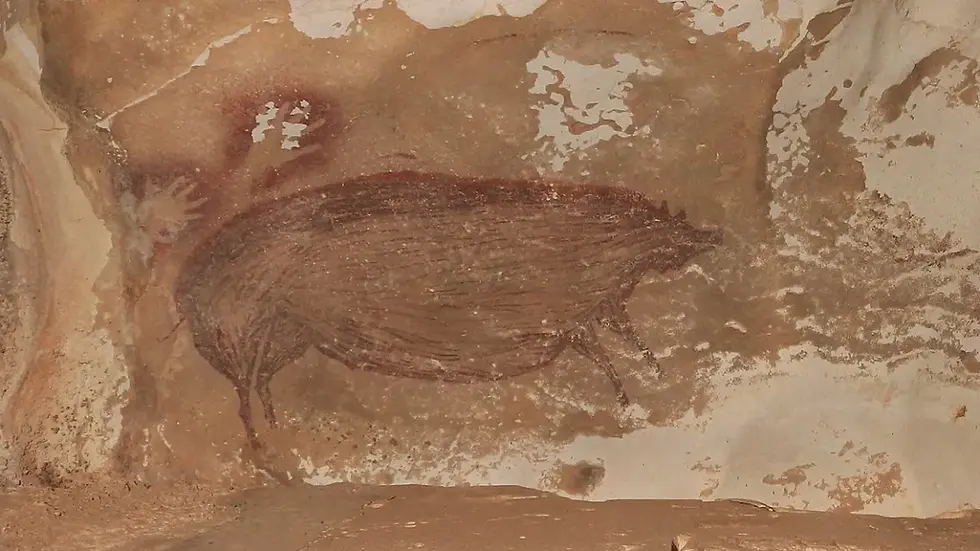
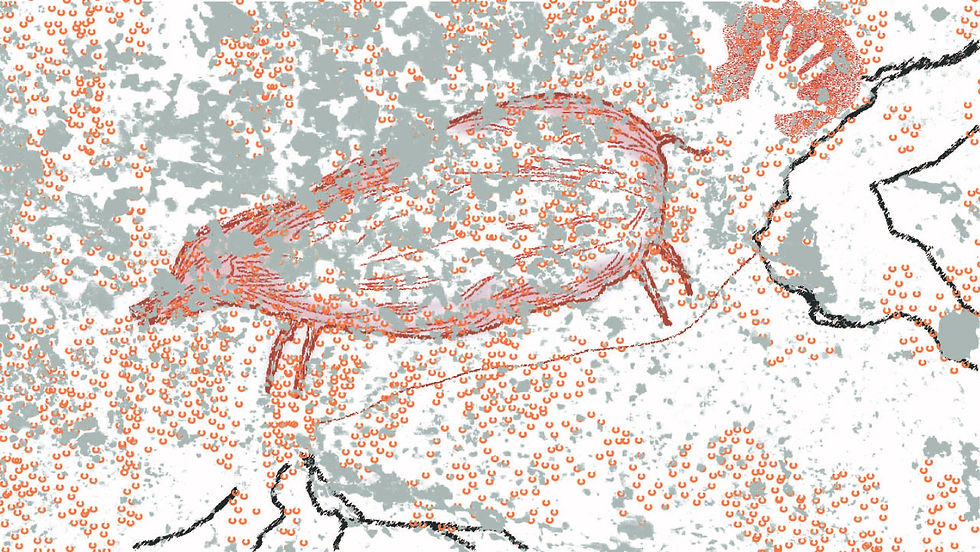
At the center of this cave is a striking, life-sized depiction of a Sulawesi warty pig (Sus celebensis). Painted with dark red ochre, the figure measures approximately 136 by 54 centimeters, making it one of the most visually commanding pieces in the region.
But this is not just a portrait, it appears to be part of a larger scene. The pig faces two other, partially preserved animals, suggesting interaction, awareness, perhaps even social behavior. This subtle detail transforms the painting from a static image into something more observational, almost documentary.
What stands out in Leang Tedongnge is the attention to anatomical detail. The form of the pig is carefully rendered, indicating not only familiarity but respect. For prehistoric communities, these animals were likely central to survival, sources of food, danger, and meaning.
The cave’s remote setting also hints at intentionality. Like other sites in the Maros-Pangkep region, this was not casual decoration. The effort required to reach the cave suggests that the act of painting itself held importance.
Leang Tedongnge reminds us that early humans were not just hunters, they were observers. They saw the world closely, and they chose to preserve it.
Leang Bulu’ Sipong 4
If Leang Karampuang marks the beginning of narrative, then Leang Bulu’ Sipong 4 is where storytelling fully emerges.
Dating between 48,000 and 51,200 years ago based on recent uranium-series analysis, this cave contains what is widely regarded as the oldest known hunting scene in human history. The artwork spans a panel approximately 4.5 meters wide and presents a complex, multi-character composition.

At its core, the scene depicts a group of small human-like figures (therianthropes) engaged in a coordinated hunt. These figures, only a few centimeters tall, possess animal-like features such as tails, snouts, or beaks. They are shown interacting with six animals: two Sulawesi pigs and four dwarf buffalo (anoa).
There is movement, tension, and strategy. Some figures appear to use ropes or spears, while others position themselves around the animals. One figure is even shown upside down, echoing the dynamic poses seen in other caves.
This is not random imagery, it is structured storytelling. There is a beginning (the hunt), a middle (the pursuit), and an implied outcome. It suggests planning, cooperation, and perhaps even mythological interpretation.
More importantly, it proves that humans at this time were capable of imagining hybrid beings and complex narratives. This challenges older theories that such cognitive abilities developed much later.
Leang Bulu’ Sipong 4 is more than art, it is evidence that, tens of thousands of years ago, humans were already thinking in stories.
Gua Pettakere
Gua Pettakere offers something deeply personal. While other caves tell stories of animals and hunts, this site captures the presence of the human individual.
The cave is famous for its collection of approximately 26 hand stencils, created using a spray technique. Prehistoric artists would place their hands against the limestone and blow a mixture of red ochre and water around them, leaving behind a negative imprint. These markings date back as far as 39,900 to 43,900 years ago, with similar stencils in the region reaching even older ages.

These handprints are often described as the earliest human “signatures.” They are simple, yet powerful, a direct, physical connection between past and present.
Some of these stencils are missing fingers, a detail that has sparked debate among researchers. This could represent ritual practices, symbolic communication, or even early forms of sign language. While the exact meaning remains uncertain, the intentionality is undeniable.
Alongside the handprints are depictions of animals, particularly the babirusa, a distinctive pig-deer native to the region. These paintings show careful observation and familiarity, reinforcing the connection between humans and their environment.
Gua Pettakere is not just about storytelling, it is about identity. It reflects a moment when humans began to mark themselves onto the world, leaving behind more than survival, leaving behind meaning.
Leang Timpuseng
Leang Timpuseng may appear modest compared to other caves, but its impact on archaeology is profound.
In 2014, the dating of a hand stencil in this cave to at least 39,900 years ago fundamentally changed our understanding of early human art. Before this discovery, many scientists believed that complex symbolic expression originated in Europe and spread outward.
Leang Timpuseng proved otherwise.
On the opposite side of the world, humans were creating art of equal complexity at the same time. This discovery reshaped the narrative of human creativity, suggesting that artistic expression emerged independently and simultaneously across different regions.
The cave features a red-ochre hand stencil (one of the oldest ever recorded) alongside a painting of a babirusa, dated to at least 35,400 years ago. Together, these images represent both the human presence and the surrounding world.
Reaching the cave today still requires effort. Located near the village of Kalabbirang, it sits high on a limestone cliff, accessible only by trekking through rice fields and uneven terrain. It remains more of a research site than a tourist destination, preserving its raw, untouched atmosphere.
Leang Timpuseng is not just a cave, it is a correction to history. It reminds us that creativity was never confined to one place. It belonged to humanity as a whole.
The Museum of Time Team
6 April 2026


Comments