Uncovering the Past: The Excavation and Archaeology of Shahr-e sukhteh (The Burnt City)
Updated: Nov 1, 2025
Buried beneath the sands of southeastern Iran lies Shahr-e Sukhteh, the Burnt City, a 5,000-year-old civilization once filled with innovation, art, and trade. But for centuries, it remained forgotten, its secrets sealed beneath layers of ash and time.
The story of its rediscovery begins not with ancient kings, but with modern explorers and archaeologists who devoted their lives to uncovering the truth behind its ruins. From Aurel Stein’s first glimpse of its scorched soil to the tireless Iranian excavations of the late 20th century, their efforts turned a nameless desert mound into one of the most important archaeological sites in the world.
Content table:

Excavation history
Who were the first to uncover the Burnt City buried beneath centuries of silence, and what did they risk to bring Shahr-e Sukhteh back to life?
The story of Shahr-e Sukhteh’s discovery begins with Sir Aurel Stein, the first archaeologist to explore Iran in depth. He visited the country four times in the early 20th century, mapping ancient routes and studying forgotten civilizations. His book “Old Routes of Western Iran” records his journeys in Iran.
During his fourth expedition (1935–1936), Stein ventured into the eastern parts of Iran and discovered the mysterious “Burnt City,” or Shahr-e Sukhteh. Despite being in his sixties, he worked with great passion, assisted by the Iranian archaeologist Bahram Karimi (بهرام کریمی). However, they only worked at the site for four days.
Decades later, in 1967, a group of Italian archaeologists led by Maurizio Tosi began the first official excavations at Shahr-e Sukhteh. Their team, called the Istituto Italiano per l’Africa e l’Oriente (IsIAO) which is translated as “the Italian Institute for Africa and the East”, excavated the site for 11 years, completing ten archaeological seasons. Unfortunately, their work came to an abrupt stop with the outbreak of the Iranian Islamic Revolution, and the site remained untouched for the next 19 years.
Finally, in 1997, excavations were resumed by an Iranian team led by Dr. Seyyed Mansour Seyyed Sajjadi, marking a new era of research at Shahr-e Sukhteh. Dr. Sajjadi had been one of the young archaeologists in the Istituto Italiano per l’Africa e l’Oriente (IsIAO) team who had previously worked on the Burnt City. When he first joined the excavations at Shahr-e Sukhteh, he was only 24 years old!
But for now, let’s talk about his own team.
they worked in extremely harsh conditions, which caused Dr. Seyyed Mansour Seyyed Sajjadi to lose 80% of the vision in his left eye during the excavation. The team endured hunger, thirst, and sandstorms while continuing their research. However, Dr. Sajjadi has said many times that he is not sad about his injury. He transformed a small guard room into what is now the Museum of Shahr-e Sukhteh, which has grown into a thriving center. Today, almost 120 families work there in different jobs, and nearby villages in the Sistan Plain now have access to water and electricity.
His team worked on the site for 12 years, but unfortunately, only about 5 or 7% of the city has been excavated so far.
Archaeology of Shahr-e Sukhteh
What secrets lie beneath the ashes of Shahr-e Sukhteh, and how did this ancient city rise, burn, and rebuild itself across the ages?
Now that we know the story of the excavations and the people behind them, let’s turn our attention to the city itself.
The settlement of Shahr-e Sukhteh first emerged around 3550 BCE and experienced three major fires before its eventual abandonment. Earlier Italian research suggested that the city was deserted around 1800 BCE, but more recent studies by archaeologists Barbara Helwing and Hassan Fazeli Nashli indicate that its decline likely occurred much earlier, around 2350–2300 BCE.
This remarkable city was carefully organized into four main parts:
a central area covering about 20 hectares,
a residential zone of roughly 16 hectares,
an industrial district in the northeast, and
a cemetery in the southwest, spanning about 20–25 hectares.

As mentioned by archaeologist Dr. Sajjadi, the residential area of Shahr-e Sukhteh lies on the highest part of the site. Pottery belonging to Period I was discovered here during excavations in the Eastern Residential Area, located just north of the Burnt Building.
At the heart of the settlement stood the Great Central Area, also known as the Central Quarters, which was separated from the western, southern, and eastern zones by deep natural depressions. Within these central quarters, archaeologists identified a structure they call the “House of the Jars.” Among the vessels found there was a remarkable Kot Dijian jar, linking Shahr-e Sukhteh to wider cultural networks of the Bronze Age.
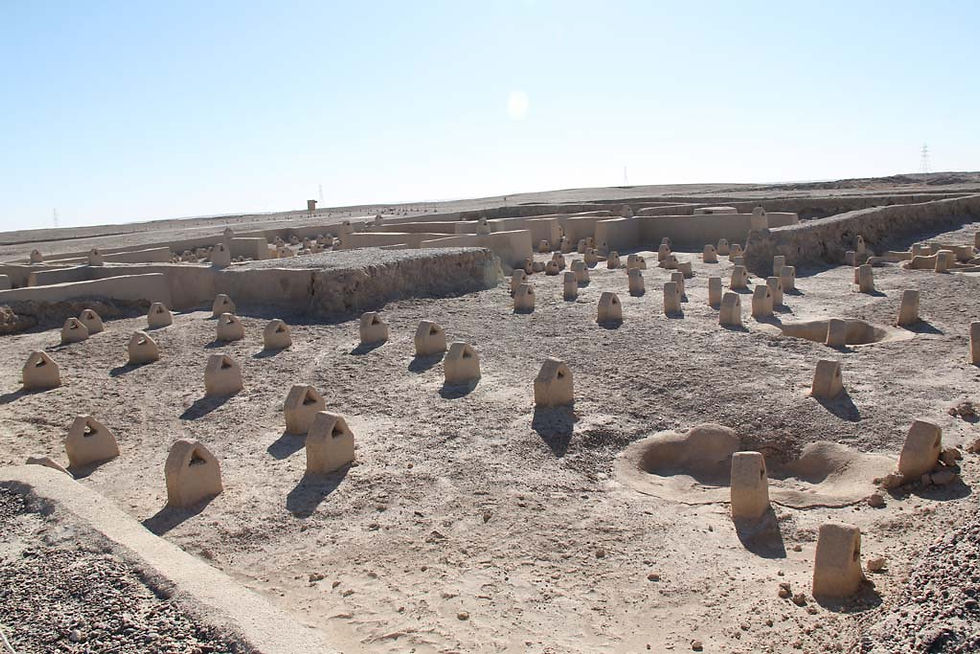
To the southwest lies the Graveyard Area, or the Cemetery of Shahr-e Sukhteh, one of the largest known burial grounds of its time. It covers a vast area and is estimated to contain between 25,000 and 40,000 graves. Most burials belong to Periods I and II, though a smaller number date to the later phases of the city’s history.
In the northwestern part of the site is the Craftsmen’s Quarter, the industrial zone of the city. Here, artisans once worked with stone, clay, and metal, producing the everyday and luxury goods that made Shahr-e Sukhteh so renowned.
Nearby, to the east of this quarter, stands the Monumental Area, distinguished by several high mounds that mark the remains of important public or ceremonial buildings.
Archaeologists also discovered pottery kilns near and around this area, though evidence suggests that most ceramic production took place outside the main settlement, perhaps in specialized workshops nearby.
The diversion of the Hirmand River during floods and the gradual rise of surface salts, which acted like a natural mortar, helped preserve the city’s monuments and artifacts. These unique environmental factors are among the key reasons why Shahr-e Sukhteh remains so well-preserved today.
As one of the largest cities of the early urban era, Shahr-e Sukhteh offers fascinating insights into ancient urban strategy, the way early civilizations planned, rebuilt, and adapted their cities in the face of natural disasters such as earthquakes, wildfires, or floods. When destruction struck, its inhabitants didn’t have modern tools or technology to rebuild from scratch. Instead, they adapted resourcefully: constructing new roads, building houses atop older foundations, and reorganizing the city layout to fit their changing needs.
With each catastrophe, the city evolved, a testament to the resilience and ingenuity of its people, who practiced complex urban planning long before modern engineering was even imagined. Archaeologists have uncovered 11 distinct layers within the site, corresponding to four major eras of urban life, all built upon one another in the same enduring settlement.

The I period
The first era marked the birth of this extraordinary city, represented by layers 8, 9, and 10, dating to around 3550–3100 BCE. During this time, Shahr-e Sukhteh likely covered an area of 10–10.5 hectares and began forming connections with other settlements in the Kandahar region, southern Turkmenistan, the Bampur Valley, and beyond. Archaeological evidence also reveals links between Shahr-e Sukhteh and the Proto-Elamite cities of Khuzestan and Fars Province, emphasizing the city’s early role in regional exchange networks.
It was during this era that people started building houses and transforming their small village into the thriving urban center we know today. Pottery workshops expanded rapidly, producing ceramics that were traded with nearby cities for profit. As we know, Shahr-e Sukhteh became a wealthy city, and much of its prosperity stemmed from this growing trade network. The final century of the first period, around 3100 BCE to 3000 BCE, marked the true beginning of its remarkable trades.
The II period
This period covers layers 5, 6, and 7, roughly between 3100 and 2620 BCE. The 7th layer, dated from 3100 to 3000 BCE, was like a bridge between two different eras of life in the Burnt City. By the time we reach the 5th layer, the city has grown into an impressive 80 hectares (about 200 acres).
During this time, Shahr-e Sukhteh began expanding its trade network, reaching the pre-Harappan centers of the Indus Valley, while still keeping its earlier connections with the Bampur Valley. The trade routes grew wider, the exchanges richer, and the city itself became wealthier and more active than ever.
In Phase 6, the settlement went through a big reconstruction. Some of the houses that had been destroyed were never rebuilt, but new structures appeared, showing how the city kept changing and adapting. It also seems that Shahr-e Sukhteh had close contact with Mundigak, another major settlement of the time. Through this route, lapis lazuli was likely brought from the Badakhshan mines, passing through Mundigak before reaching Shahr-e Sukhteh. Because of these strong cultural and economic ties, archaeologists often speak of a shared Helmand Civilization that connected these regions.
In this same era, Area 33, one of the main residential parts of the city, revealed a lot about Shahr-e Sukhteh’s architectural growth, especially after the first major fire around 2700 BCE. Houses became larger and more organized, often with several rooms and open courtyards. Like most Bronze Age Persian architecture, they were built using the traditional mudbrick technique, giving the city its distinctive earthy look.
By the time we reach Phases 5 and 6, everything in Shahr-e Sukhteh feels more connected, more alive. The city was thriving, bigger, busier, and more innovative. The 7th phase marks the start of what could be called the golden age of the Burnt City. Alongside its beautiful pottery, people began producing jewelry and refining their ceramic technology. They used finer materials and better firing techniques, resulting in pottery with denser, smoother surfaces. Most of the ceramics from this time (whether made locally or imported) were buff and gray wares decorated in shades of brown and black.
The III period
This period covers the late 4th layer and continues through layers 3 and early 2, lasting roughly two centuries, from about 2600 to 2400 BCE. It represents the third stage of urban development in Shahr-e Sukhteh, when the city reached the peak of its cultural and architectural sophistication.
Phase 4 is often seen as a transitional stage, bridging the end of the second era and the beginning of the third. It was a relatively short phase, lasting perhaps a single generation, between 2620 and 2600 BCE! but it marked a significant change. During this time, large buildings with thick surrounding walls were constructed, pottery styles evolved, and the once-painted decorations gave way to simpler, more standardized forms. Burials began to reflect growing social and economic differences, showing that the community had become more structured and stratified. Interestingly, the imported goods from Mesopotamia and western Iran, which had been common before, seem to vanish by the end of this phase.
Moving into Phases 3 and 2, we see the continuation of many features introduced earlier. Buildings remained large, still enclosed by substantial walls, and the overall architectural style did not change drastically from Phase 4. The settlement pattern became more organized, and evidence suggests that social hierarchy continued to shape everyday life. The city also maintained its trade connections with Mundigak, the Bampur Valley, and the Indus Civilization, keeping Shahr-e Sukhteh active within the broader Helmand cultural network.
What’s particularly fascinating about Phase 3 is the evolution of pottery. Ceramics from this time show new forms and motifs that differ greatly from earlier periods. Early in this phase, the simple decorations of previous eras became more elaborate. By the end of the period, gray-paste pottery with black decoration became common, along with small, thin-walled bowls that were often left undecorated, a sign of growing refinement in craftsmanship and technique.
This era is often described as the golden age of Shahr-e Sukhteh. The city began producing its own high-quality artifacts: delicate jewelry and beads, fine ceramics, stone vessels, and metal tools. Architecture also became more planned with residential areas, craft districts, and public buildings arranged in a more systematic way. Some large structures with multiple rooms and courtyards may have served administrative or communal purposes.
Several extraordinary discoveries belong to this time: the board game, the artificial eye, and even evidence of surgical practices, all testifying to the intellectual and technological achievements of its people.
Social differences became more visible in burial practices. Some graves were richly furnished with jewelry, decorated vessels, and exotic materials, while others were modest, showing the clear presence of wealth and class distinctions.
Despite all this prosperity, the end of the third period shows signs of gradual decline. Environmental changes, shifts in trade routes, or internal challenges may have weakened the city’s stability, leading slowly toward the decline and eventual abandonment that followed in later centuries.
Even Building 33, located in Area 33 between the Central and Monumental Quarters, belongs to this flourishing time. It was radiocarbon-dated by Enrico Ascalone’s team to around 2600–2450 BCE, perfectly fitting into the city’s golden age.
The IV period
This era marks the final chapter in the life of Shahr-e Sukhteh, the time when the once-great city slowly shrank into a small village and, eventually, disappeared altogether. By then, the Helmand River and the ancient inland sea of southeastern Persia were drying up, leaving the region without the water resources that had once sustained its people.
This period includes the late 2nd layer through layers 1 and 0, covering roughly 2400 to 2000–1800 BCE.
During Period IV (around 2400–2300 BCE), excavations uncovered what archaeologists call the “Burnt Palace” or “Burnt Building.” Evidence from this time shows that Shahr-e Sukhteh’s contacts were now limited mostly to the Bampur Valley and the Kandahar region, as seen in the distinctive Bampur V and VI pottery found on site.
In 1972, archaeologists discovered several processing workshops in the city’s western quarters, containing large concentrations of flint, lapis lazuli, and turquoise. These workshops are unique in the region and show that, even in its final centuries, Shahr-e Sukhteh remained a place of craftsmanship and trade, though on a smaller scale.
Between the first phase and phase 0, there was a clear gap! a period of abandonment. Recent excavations by Enrico Ascalone in Area 33 revealed this phase of abandonment, radiocarbon-dated to 2450–2350 BCE. However, archaeologist Massimo Vidale considers this the last phase of full urban life in Shahr-e Sukhteh, the final moment when the city still functioned as a true settlement before fading away.
Later excavations by Iranian archaeologists Dr. Sajjadi and Hossein Moradi (2014–2015) uncovered a system of semi-columns in a long passage between two buildings in Area 26, belonging to Period IV. Vidale believes this structure may have been part of a palatial compound, remarkably similar to one discovered years earlier in Mehrgarh, dated around 2500 BCE by a French archaeological mission.
According to Ascalone, after a long abandonment between 2350 and 2200 BCE, the Burnt Building appears to have been reoccupied in phase 0 (ca. 2100–2000 BCE). This dating, first proposed by Raffaele Biscione in 1979, may indicate a brief survival of the older urban center, though Vidale suggests that the urban system itself had already collapsed by around 2350 BCE.
Earlier excavators Maurizio Tosi and Raffaele Biscione also believed the Burnt Building met its end in a destructive fire around 2000 BCE, closing the final chapter of Shahr-e Sukhteh’s remarkable story.
Conclusion
Today, after decades of excavation, only about five percent of Shahr-e Sukhteh has been unearthed, yet even that small portion has rewritten what we know about early urban life in the Bronze Age. Every jar, every wall, every grave tells a story of resilience, knowledge, and connection across ancient civilizations.
The work of Aurel Stein, Maurizio Tosi, and Dr. Seyyed Mansour Seyyed Sajjadi revealed not just an ancient city, but a mirror of human ingenuity, proof that even in the harshest deserts, culture and creativity can flourish.
But our exploration doesn’t end here. What have archaeologists actually found inside this mysterious city, the artifacts, tools, and secrets buried beneath the ashes?
author: The Museum of Time, Asal Mirzaei
30 October 2025, lastest update


Comments