Akhenaten Biography: The Pharaoh Who Tried to Change Egypt
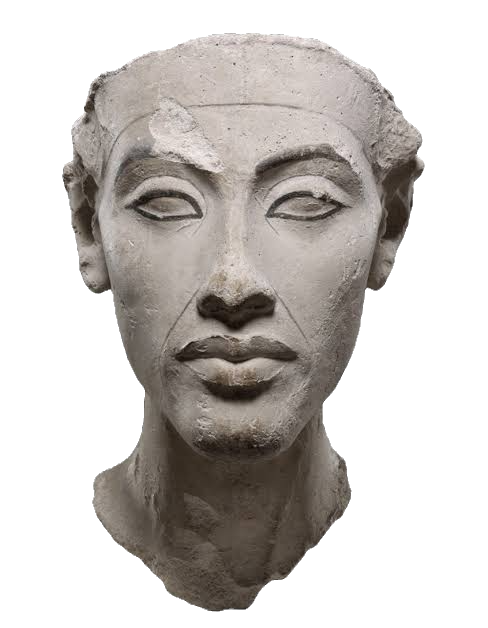
There are few figures in ancient Egyptian history as fascinating... or as unsettling as Akhenaten. For centuries, Egyptian kings had ruled within a religious world filled with gods, temples, rituals, and traditions that reached deep into the country's past. Then, in the fourteenth century BCE, a pharaoh appeared who began to challenge much of that world. He changed his own name, elevated the sun disk Aten above the traditional gods, moved the royal court to a new city in the desert, and commissioned an artistic style unlike anything Egypt had seen before.
Akhenaten biography is not simply the story of a pharaoh who changed Egyptian religion. It is the story of a deeply unconventional ruler, his beliefs, temperament, relationships, ambitions, family life, and the way he used royal power to turn his personal vision into reality.
His reign was brief, but its consequences were extraordinary. He transformed Egyptian religion, royal imagery, architecture, and even the way the king and his family were represented in art. His wife, Nefertiti, stood beside him as one of the most recognizable women of ancient Egypt, while their daughters appeared repeatedly in royal scenes.
Yet Akhenaten's revolution did not survive him. After his death, much of what he had built was abandoned, his religious changes were reversed, and later Egyptians attempted to erase his memory.
So who was the man behind this extraordinary experiment, and... why did he try to change Egypt?
Content Table
Who Was Akhenaten?
Akhenaten was an Egyptian pharaoh of the 18th Dynasty, who ruled during the fourteenth century BCE, conventionally dated to approximately 1353–1336 BCE, although exact chronology can vary slightly between scholarly reconstructions. He was born Amenhotep IV, the son of Pharaoh Amenhotep III and Queen Tiye, and would inherit a kingdom at the height of the New Kingdom's power.
At first glance, there was little to suggest that this royal prince would become one of Egypt's most controversial kings.
He had been born into privilege. His father presided over an extraordinarily wealthy and internationally connected Egypt, while his mother, Tiye, was an influential queen whose importance extended well beyond the conventional image of a royal wife. Akhenaten grew up within a court where religion and kingship were inseparable. The pharaoh was not merely a political ruler; he occupied a sacred position between humanity and the divine.
Yet Akhenaten would eventually challenge the religious order that had supported Egyptian kingship for generations.
Early in his reign, he was known as Amenhotep IV, a name connected to the god Amun. But as his religious ideas developed, he increasingly promoted the Aten, represented as the visible disk of the sun whose rays ended in hands reaching toward the royal family. Eventually, he changed his name to Akhenaten, generally understood as meaning something like "Effective for the Aten" or "Beneficial to the Aten."
The change was more than cosmetic.
Akhenaten's religious program gradually pushed the traditional gods away from the center of royal life. The Aten became the focus of royal worship, while traditional divine imagery and institutions were increasingly suppressed. Temples associated with other gods were closed or neglected, and the name of Amun, one of Egypt's most powerful deities, was attacked in some inscriptions.
But Akhenaten did not simply introduce another Egyptian god into an already crowded pantheon. His vision placed the Aten in an extraordinarily privileged position, with the king and his family acting as the principal intermediaries through whom the Aten's divine power reached humanity.
This idea transformed almost everything around the pharaoh!
The royal family became central to religious imagery. Akhenaten, Nefertiti, and their daughters were repeatedly shown beneath the rays of the Aten, receiving life from the sun disk. Egyptian artists abandoned many of the idealized forms traditionally used for royal portraits and created images of Akhenaten with unusual physical features and exaggerated forms. Whether these representations reflected his actual appearance, religious symbolism, artistic experimentation, or some combination of all three remains debated.
Then came perhaps his boldest decision.
Akhenaten abandoned the traditional royal center at Thebes and established a new capital farther north, at a site that he called Akhetaten, meaning approximately "Horizon of the Aten." Modern historians know the site as Amarna.
There, in a landscape that had not previously been one of Egypt's great political centers, Akhenaten attempted to build a city devoted to his new religious order.
For a short time, the experiment flourished.
Palaces, temples, residences, administrative buildings, and royal monuments rose beneath the Egyptian sun. The new city became the stage for a radically different vision of kingship. Akhenaten and Nefertiti were not represented merely as distant divine rulers. They appeared as a family, sometimes accompanied by their daughters, embracing, dining, and receiving the rays of the Aten.
Yet the same revolution that made Akhenaten extraordinary also made his reign fragile.
Traditional temples, priests, and religious traditions had deep roots throughout Egypt. Akhenaten's reforms disrupted institutions that had existed for centuries, and the new capital depended heavily on the continued authority of one king and his court. When Akhenaten died, the system he had created quickly began to unravel.
His successors restored the worship of traditional gods, abandoned Akhetaten, and gradually worked to remove Akhenaten's name from official memory. For generations afterward, he was treated less like a legitimate pharaoh and more like a dangerous interruption in Egypt's history.
And yet the attempt to erase him failed.
More than three thousand years later, Akhenaten remains one of ancient Egypt's most discussed rulers, not because he ruled for a particularly long time or conquered enormous territories, but because he dared to imagine that Egypt itself could worship, build, and see the world differently.
That is what makes Akhenaten's story so compelling. He was not simply a pharaoh who worshipped the sun. He was a king who attempted to reshape the relationship between god, ruler, family, art, and society, and for a brief moment, he succeeded.
Royal Beginnings: Family, Childhood, and the Prince Who Would Become
Pharaoh
Before Akhenaten became the king who challenged Egypt's religious traditions, he was simply a royal child growing up in one of the most powerful courts of the ancient world.
He was born Amenhotep IV, probably during the reign of his father, Amenhotep III, around the middle of the fourteenth century BCE. His exact date of birth is unknown, as is much of his childhood. Ancient Egyptian records were far more interested in presenting kings as established rulers than in preserving intimate childhood biographies. There is no surviving diary describing the young prince's temperament, no teacher's account telling us whether he was difficult or curious, and no childhood letter in which he explains what he dreamed of becoming.
What we have instead are fragments: royal inscriptions, monuments, family representations, later archaeological discoveries, and the political world into which he was born.
And that world matters.

Akhenaten was the son of Amenhotep III, one of the most successful rulers of Egypt's 18th Dynasty, and Queen Tiye, an exceptionally prominent woman who appears to have exercised considerable influence at court. Amenhotep III's reign was characterized less by constant military conquest than by enormous wealth, diplomacy, monumental construction, and international connections. Egypt stood at the center of a sophisticated diplomatic network linking it with kingdoms across the Near East.
The young prince therefore grew up surrounded by extraordinary luxury.
Palaces, temples, gardens, servants, scribes, priests, soldiers, foreign envoys, craftsmen, and members of the royal administration would have formed the world of his childhood. Religion was everywhere. The gods were not distant ideas reserved for temples; they were woven into kingship, festivals, architecture, language, and daily life.
And among those gods, Amun held enormous importance.
At the same time, the royal household was not simply a peaceful little family living behind palace walls. It was a political institution. Every marriage, title, birth, religious ceremony, and public appearance could carry political meaning.
Akhenaten was therefore raised from the beginning to understand that being royal meant being watched, represented, and expected to embody something larger than oneself.
Among the people who shaped his early world, Tiye deserves particular attention.
She was not merely the woman who gave birth to the future pharaoh. Tiye was an important political figure during Amenhotep III's reign and continued to appear prominently in royal monuments and diplomatic correspondence. Her influence is particularly striking because she did not come from the highest levels of Egyptian royal ancestry usually associated with queens.
Her prominence may have taught her son something that would become important later: the power of royal identity did not depend entirely upon ancient tradition.
We have to be cautious here. There is no evidence allowing us to say that Tiye personally taught Akhenaten to challenge the traditional religious order. That would be speculation. But she clearly belonged to a royal environment in which women could possess political and symbolic importance, and Akhenaten later placed extraordinary emphasis on the royal family as a unit.
His relationship with his mother appears to have remained important throughout his life. Tiye survived Amenhotep III and was still alive during part of Akhenaten's reign, eventually appearing at Akhetaten. Her presence there is significant: the older generation of the royal family was not simply erased when Akhenaten introduced his new religious vision.
Also, Akhenaten was not raised alone, His known or possible siblings included Thutmose, Sitamun, Henuttaneb, Nebetah, and Iset, although the exact family relationships and succession circumstances are not always completely clear.
One particularly important figure was Crown Prince Thutmose, who appears to have been Amenhotep III's eldest surviving son and heir before his premature death. Thutmose's disappearance from the historical record left the succession open to his younger brother.
This is an important turning point.
Akhenaten did not necessarily grow up expecting that he would become pharaoh. He may originally have occupied the position of a secondary prince within a large royal household, while his elder brother stood closer to the throne.
Then circumstances changed.
When Thutmose died, Amenhotep IV eventually became heir.
We do not know precisely how this affected the young prince. There is no surviving account of him suddenly realizing, I will be king. But the change would have transformed his life. His education, public responsibilities, religious training, and relationship with the royal court would all have taken on greater significance.
The future ruler of Egypt was being prepared.
but... What Kind of Child Was He?
This is where the historical record becomes frustrating, and fascinating!
We cannot reconstruct Akhenaten's personality from childhood with certainty.
Later artistic representations of him cannot simply be treated as photographs. His unusual body shape, elongated face, narrow limbs, and distinctive physical features have produced centuries of speculation about his health and appearance. Modern scholars have proposed different explanations, but none should be treated as a simple diagnosis based solely on royal art.
More importantly, the artistic style of Akhenaten's reign was deliberate and symbolic.
So rather than asking whether the statues give us his literal face, we should ask what they tell us about how Akhenaten wanted himself to be seen.
That becomes one of the most interesting questions throughout his biography.
The same king who later presented himself with an unconventional physical appearance also abandoned many traditional artistic conventions. He allowed royal scenes to become more expressive, more fluid, and sometimes remarkably intimate. His family could be shown interacting beneath the rays of the Aten rather than appearing in the rigid formal compositions that had dominated much earlier royal imagery.
Something about Akhenaten's reign encouraged artists to look at kingship differently.
Whether this came from the king himself, his religious ideology, his court, or a combination of influences remains difficult to determine. But it certainly tells us that he was comfortable with breaking established visual conventions.
At some point of family dramas, Amenhotep IV became king.
The exact chronology of his early reign remains a subject of scholarly discussion, but his first years did not immediately look like the radical revolution that would come later. He continued to use the traditional royal name Amenhotep, and he did not begin his reign by instantly destroying every traditional religious institution.
Instead, his religious transformation appears to have developed over time.
This gradual development is important because it complicates the popular image of Akhenaten as a young prince who suddenly decided that every Egyptian god except the Aten must disappear.
The evidence suggests something more complicated.
His fascination with the solar deity grew. The Aten became increasingly prominent in royal ideology. His relationship with the powerful god Amun and the traditional religious establishment eventually became deeply confrontational. His own name changed. His capital changed. Egypt's artistic language changed.
But the man who made those decisions had first spent years inside the very world he would later challenge.
He had been educated within the Egyptian religious system.
He had been raised by a king who built enormous monuments to the traditional gods.
He had grown up surrounded by priests, rituals, royal ceremonies, and the traditions of his ancestors.
Akhenaten knew the world he was overturning.
That may be one of the most important facts about him.
He was not an outsider who wandered into Egypt and imposed a foreign religion. He was a product of the Egyptian royal system itself, a prince born into its traditions who eventually decided that those traditions no longer represented the religious truth he wanted to place at the center of kingship.
And somewhere during the transition from prince to pharaoh, Amenhotep IV began becoming the man history would remember as Akhenaten.
The transformation was still ahead.
But the first rays of the Aten were already beginning to brighten the royal horizon.
A New God, A New Vision: The Rise of the Aten
At the beginning of his reign, Akhenaten was still Amenhotep IV, a king operating within the religious world inherited from his father. Egypt had never been a society in which religion and government could easily be separated. The temples were wealthy institutions, priests held influence, and the gods were woven into nearly every aspect of royal life.
Then the king began looking toward the sun.
The Aten was not entirely new. Solar imagery and forms of the sun god had existed in Egypt long before Akhenaten. What was unusual was the extraordinary importance the new king gave to the Aten and the increasingly exclusive place he created for it within royal worship.
At first, the transformation was gradual.
Akhenaten continued to use the traditional royal name Amenhotep IV, and early monuments still included familiar religious elements. But the Aten began appearing more prominently in royal inscriptions and imagery. Instead of being represented simply as another divine figure among many, the Aten was increasingly presented as the source of life itself.
The change eventually became impossible to ignore.

The Aten was represented as a solar disk, its rays extending downward toward the royal family. At the ends of those rays were tiny hands, sometimes holding the symbol of life, the ankh, toward the king and his family.
This imagery was radically different from the conventional representations of Egyptian gods.
The Aten did not appear as a human figure with a divine animal head. It was not given the elaborate mythology associated with gods such as Amun, Osiris, Isis, or Horus. Instead, the Aten was something visible in the sky: the sun disk whose light reached across the world.
Akhenaten's religious language emphasized this universal quality.
The sun rose over Egypt and foreign lands alike. Its light reached humans, animals, plants, and landscapes without distinction. In the famous Great Hymn to the Aten, traditionally associated with Akhenaten's religious world, the sun's daily cycle is presented as the force that sustains life.
This helps explain something important about Akhenaten's religious vision.
The Aten was not merely a sun god in the ordinary Egyptian sense.
Akhenaten increasingly presented the Aten as the ultimate source of creation and life, while the king and his family occupied a unique position between the Aten and humanity.
That last part is crucial.
Akhenaten's religion did not simply mean that every Egyptian suddenly worshipped the sun personally. The royal family became extraordinarily important as the Aten's earthly representatives.
The king stood at the center.
Eventually, the transformation reached Akhenaten's own identity!
He abandoned the name Amenhotep IV, which connected him to the god Amun, and adopted the name Akhenaten.
A king's name in ancient Egypt was never merely a private label. Royal names carried religious meaning and formed part of the king's public identity.
Changing his name therefore made a powerful statement:
The king himself was now publicly identifying his existence with the Aten.
It was not enough for him to build a temple to the Aten. He wanted his entire identity as pharaoh to be connected to this deity.
This is one of the clearest windows into Akhenaten's personality.
Whatever else we may say about him, he appears to have been deeply committed to his religious vision. He did not merely experiment with a fashionable cult while leaving the rest of Egyptian religion untouched. He gradually reorganized royal ideology around the Aten and eventually made his own identity part of that transformation.
Traditional Egyptian religion was not immediately erased everywhere in the country. Nor should we imagine that every Egyptian simply abandoned the old gods overnight.
Egypt was enormous, and religious life continued in homes, local communities, temples, and regional centers.
But at the level of the monarchy, Akhenaten increasingly attacked the traditional religious order.
The name of Amun, especially, was removed from some inscriptions. Temples associated with traditional gods were closed, neglected, or stripped of their privileges. Images and names connected with certain deities were damaged or erased.
The scale and exact chronology of this process remain subjects of scholarly debate, but its significance is clear.
Akhenaten was not merely adding a new god.
He was challenging institutions that had existed for generations.
And this tells us something about his character as a ruler.
Akhenaten appears to have been willing to use the enormous authority of the Egyptian monarchy to enforce a religious vision that was deeply personal and deeply unconventional.
Whether that makes him "religiously devoted," "authoritarian," or something in between depends partly on interpretation.
But there is little reason to think that he was indifferent.
His actions required enormous political commitment.
Perhaps nowhere is Akhenaten's new religious world more visible than in the way he represented his family.
His wife Nefertiti appears beside him again and again. Their daughters are shown accompanying their parents, sometimes in scenes that are surprisingly intimate for Egyptian royal art.
The family sits together.
The daughters reach toward their parents.
Akhenaten and Nefertiti sometimes appear physically close.
The Aten's rays descend upon them.
These scenes are extraordinary because the royal family is not merely presented as a political unit. It becomes part of the religious structure itself.
The king, queen, and children form the human center of the Aten's worship.
This does not necessarily mean that Akhenaten was simply a sentimental father who wanted to display his family.
The imagery had a religious purpose.
Yet the repeated emphasis on family affection is still revealing.
Akhenaten's religious worldview seems to have given unusual importance to the royal household itself. Instead of presenting the king as a distant, almost motionless divine figure, his art could show him as a husband and father.
It is one of the most humanizing aspects of his otherwise radical reign.
Akhenaten's revolution was not limited to religion.
It changed art!
Traditional Egyptian royal art had developed highly recognizable conventions. Kings were usually represented with idealized bodies, formal poses, and proportions that communicated order, permanence, and authority.
Akhenaten's artists broke many of those expectations.
The king was shown with an elongated face, narrow limbs, a pronounced belly, broad hips, and a distinctive physical form. His family was represented in similarly unconventional ways.
For centuries, people have attempted to explain these images literally.
Was Akhenaten physically unusual?
Did he suffer from a medical condition?
Was the art symbolic?
The honest answer is that we cannot confidently reduce the imagery to a diagnosis.
The more interesting point is that Akhenaten allowed himself to be represented this way.
That suggests something about his attitude toward royal imagery. He was prepared to abandon artistic conventions when they no longer suited the world he wanted to create.
His reign therefore produced something unusual in Egyptian history: a ruler whose personal religious ideology visibly transformed the artistic language of kingship.
Yet there was a contradiction at the heart of Akhenaten's vision.
He emphasized the Aten as universal (the sun's light reached everyone) but access to the Aten was still heavily mediated through the king and royal family.
The king remained central.
The new religion therefore did not necessarily create a world in which ordinary Egyptians stood directly before their god as equals. Instead, it strengthened the extraordinary religious importance of Akhenaten himself.
This is one reason scholars are cautious about simply calling Akhenaten's religion "monotheism."
The term can be useful as a shorthand, but ancient Egyptian religious ideas do not fit neatly into modern categories. Scholars have debated whether Akhenaten practiced monotheism, monolatry, henotheism, or something more unique.
What matters is that Akhenaten increasingly treated the Aten as the only deity worthy of central royal devotion, while traditional gods were pushed aside.
And he was prepared to reorganize the Egyptian state around that conviction.
By the later years of his reign, Akhenaten's transformation had become physical.
The old religious center at Thebes was no longer enough.
The king wanted a place where the Aten could reign without the weight of Egypt's ancient religious landscape surrounding him.
So he chose a new location.
There, between the cliffs and the Nile, he began creating a city dedicated to his god.
He called it Akhetaten, the Horizon of the Aten.
And this was more than the construction of another Egyptian capital.
It was an attempt to build an entire city around a new religious worldview.
The temples, palaces, houses, artistic workshops, administrative buildings, and royal spaces would all become part of Akhenaten's experiment.
For perhaps the first time in Egyptian history, a king was not simply adapting himself to the sacred landscape inherited from his ancestors.
He was trying to build a new sacred landscape of his own.
The desert horizon became his canvas.
The Aten became its center.
And Akhenaten, standing between the sun and his people, placed himself at the heart of it all.
Akhetaten: The City Built for the Sun

When Akhenaten decided to leave the traditional royal center of Thebes, he did something far more radical than simply moving his palace.
He chose a piece of land that had not previously been one of Egypt's great political or religious centers and declared that it would become the home of a new capital.
There was no ancient royal tradition binding the place to his ancestors. No great temple complex dominated the landscape. No powerful priesthood had centuries of history there.
It was, in a sense, a blank page.
Akhenaten named the new city Akhetaten, meaning approximately "Horizon of the Aten."(Today, the site is known as Amarna)
The choice itself tells us something about the king.
Akhenaten did not merely want to reform the old religious world. He wanted to create a space where his new vision could exist without being surrounded by the institutions and traditions he was challenging.
He was starting again.
The location of Akhetaten lay on the eastern bank of the Nile, in a broad area bordered by cliffs. Akhenaten formally marked the boundaries of his new city with a series of boundary stelae, monumental inscriptions carved into the surrounding cliffs.
These inscriptions are among the most valuable sources for understanding his intentions.
The king presented the site as something chosen specifically for the Aten. He described himself as having discovered the place as the appropriate location for his god, emphasizing that it had not previously belonged to another deity in the same way.
That distinction mattered.
Akhenaten wanted Akhetaten to be fundamentally Aten's city.
The landscape itself became part of his religious program.
The cliffs surrounding the city could be associated with the horizon, while the sun rose over the eastern desert and illuminated the new royal center. The geography therefore became part of the symbolism.
For Akhenaten, nature and religion were not separate things.
The rising sun, the Nile, the mountains, the city, and the royal family could all be brought together into one carefully constructed vision.
Once the decision had been made, construction began on an enormous scale.
Akhetaten developed remarkably quickly.
Palaces, temples, administrative buildings, houses, workshops, roads, gardens, and ceremonial spaces appeared across the site. Officials, craftsmen, laborers, priests, soldiers, servants, and entire families were brought into the new settlement.
The city was not merely a religious sanctuary.
It was a functioning capital.
Government business had to continue. Food had to be supplied. Goods had to be produced. Officials needed offices, craftsmen needed workshops, and thousands of people needed somewhere to live.
This makes Akhetaten particularly interesting when we think about Akhenaten as a person.
His religious vision was enormously ambitious, but it was not simply an abstract idea.
He was willing to turn that idea into physical reality.
He relocated the center of royal government and created an entirely new urban environment around his beliefs.
That required confidence, organization, resources, and an extraordinary willingness to disrupt established routines.
At the center of the city were temples dedicated to the Aten.
Their design differed significantly from traditional Egyptian temples.
Traditional temples often contained increasingly sacred spaces leading toward enclosed sanctuaries. Access became more restricted as one moved inward, and the architecture emphasized mystery, darkness, and the hidden presence of the deity.
The Aten temples at Akhetaten were different.
They were designed to be open to the sunlight.
Large courtyards allowed the rays of the sun to fall directly onto altars and offering tables. Instead of hiding the god within a dark sanctuary, the architecture exposed the sacred space to the sky.
That makes perfect sense within Akhenaten's religious philosophy.
The Aten was visible.
The sun itself was the manifestation through which people experienced its power.
Why hide the god in darkness?
Instead, the city opened itself toward the sky.
The architecture therefore became a physical expression of Akhenaten's theology.
Among the most important structures was the Great Aten Temple, a massive complex dedicated to the solar deity.
Although much of it has not survived intact, archaeological evidence reveals a series of open spaces and offering areas designed around exposure to sunlight.
The scale of the temple demonstrates that Akhenaten's religious experiment was supported by enormous royal resources.
Thousands of offerings were required.
Priests and officials had responsibilities.
Craftsmen produced objects for the cult.
The temple economy had to function.
Behind the king's grand religious vision was therefore an enormous administrative machine.
Akhenaten may have rejected many traditional religious structures, but he still needed a functioning bureaucracy to make his new system work.
That tension appears throughout his reign.
He wanted to overturn the old order, yet he remained dependent upon the machinery of kingship.
Akhetaten was also the stage on which Akhenaten's family became more visible than perhaps any previous Egyptian royal household.
The king, Nefertiti, and their daughters appear repeatedly in reliefs throughout the city.
The scenes can be surprisingly intimate.
The royal daughters are shown sitting close to their parents. They appear to touch or embrace one another. In some scenes, Akhenaten and Nefertiti are shown together beneath the Aten's rays while their children surround them.
The effect is striking.
The royal family seems almost domestic.
But there was still a political message beneath the tenderness.
The family was not merely being shown as a family.
It was being presented as the central human channel through which the Aten's blessing reached Egypt.
The Aten's rays often end in hands offering the ankh, the sign of life, to the king and queen.
This meant that family affection and religious authority could exist in the same image.
Akhenaten's household had become part of his theology.
What Was Life Like in Akhetaten? well...
For the people who lived there, however, the city was not simply a beautiful religious experiment.
Archaeology gives us glimpses of ordinary life.
Residential neighborhoods reveal houses of very different sizes. Some belonged to wealthy officials, while others were considerably more modest. Workshops produced pottery, glass, faience, jewelry, and other objects.
The remains of food, tools, buildings, and burial sites help reconstruct the lives of people who would otherwise have disappeared completely from history.
And these discoveries complicate the glamorous image of the Amarna court.
Evidence from the workers' cemetery, particularly skeletal remains, has suggested that some laborers experienced difficult living and working conditions, including injuries, nutritional stress, and physically demanding labor.
We should be careful about directly blaming Akhenaten for every hardship discovered at the site. Large Egyptian building projects had always required enormous amounts of labor, and harsh conditions were not unique to Akhetaten.
But the evidence reminds us of something important:
Akhenaten's magnificent vision had a human cost.
Behind the grand temples and beautiful reliefs were thousands of ordinary people who had to build, feed, maintain, and ultimately sustain the new capital.
Akhetaten was unconventional in other ways too.
Its art, architecture, and urban organization all reflected the king's unusual approach.
There was a sense of openness in the religious spaces. There was greater naturalism in artistic representations. The royal family occupied an unusually prominent place. The entire city was oriented toward a religious idea that had been elevated by one ruler.
It was almost as though Akhenaten had taken his own mind and attempted to turn it into a city.
That may be the most revealing thing about Akhetaten.
The city was not merely where Akhenaten lived.
It was what Akhenaten believed made visible.
His fascination with the Aten became architecture.
His religious exclusivity became political geography.
His emphasis on the royal family became monumental art.
His rejection of certain traditions became urban planning.
And his confidence in his own religious vision became a city built from the ground up around it.
But What Happens When the King Is Gone? There was an obvious weakness in this extraordinary experiment.
Akhetaten depended heavily on Akhenaten himself.
The city had been founded by his authority, The temples existed because of his religious program, The royal family stood at the center of its ideology, The population had been gathered around a capital whose reason for existence was deeply connected to one particular king and his god.
What would happen when that king died? History would eventually provide the answer.
Akhetaten would not become the permanent center of Egypt.
Within a few years of Akhenaten's death, the city was abandoned as the royal capital. Its temples were dismantled, its monuments were reused, and its buildings gradually fell into ruin. Later rulers actively distanced themselves from Akhenaten's religious experiment.
The city that had once represented a new beginning became a ghost of one.
Yet its remains survived beneath the desert and thousands of years later, those ruins would allow archaeologists to reconstruct something that Akhenaten's successors had tried to destroy: a glimpse of the world as Akhenaten himself wanted it to exist.
A city beneath the sun. A royal family at its center, and a pharaoh attempting, for one extraordinary moment, to make Egypt live according to his own vision.
The Pharaoh and His Family: Nefertiti, Children, and Life at Court
If there is one part of Akhenaten's life where the surviving evidence allows us to see something approaching a human being rather than simply a king, it is his family.
The walls of Akhetaten preserve an extraordinary number of scenes of Akhenaten, his great royal wife Nefertiti, and their daughters. They appear together beneath the rays of the Aten, receiving the symbol of life from the sun disk. Sometimes they sit together. Sometimes their children are gathered around them. Some scenes are formal and ceremonial, while others have an unusual sense of intimacy.
For an Egyptian king, this was striking.
Royal families had always appeared in Egyptian art, but Akhenaten's family could be represented with an unusual degree of physical closeness. His daughters were not simply decorative figures standing beside their parents. They appear as children, with their parents, with one another, and within the religious world Akhenaten had constructed.
This does not allow us to conclude that Akhenaten was certainly a gentle or affectionate father in private. Ancient royal art was carefully constructed, and these scenes served a religious purpose. But the fact that Akhenaten repeatedly chose to present his family in this way is itself significant.
Family was central to the image of kingship he wanted to create.

The heart of this family was Nefertiti.
Her origins remain uncertain, and many details of her early life are still debated. What is much clearer is the extraordinary prominence she achieved during Akhenaten's reign.
She was not presented as a passive royal wife.
Nefertiti appears beside Akhenaten in religious scenes, ceremonies, and official representations, sometimes occupying an unusually powerful visual position. In certain reliefs, she is almost as prominent as the king himself.
She even appears performing acts that were traditionally associated with the pharaoh, including scenes of smiting enemies.
The symbolism was unmistakable.
Nefertiti was not simply accompanying Akhenaten through his religious revolution. She was part of its public face.
Whether she personally shared Akhenaten's deepest religious convictions is impossible to determine. Yet the evidence suggests that she participated actively in the royal ideology surrounding the Aten.
Their partnership was therefore political, religious, and familial all at once.
And there is something else worth noticing.
The Amarna reliefs sometimes portray Akhenaten and Nefertiti not as distant divine rulers but as a couple.
Their daughters sit between them. Their bodies turn toward one another. Their children reach toward them.
The king who could appear extraordinarily unconventional in official art also seemed determined to show the royal household as emotionally connected.
Perhaps this was genuinely important to him.
Perhaps it was propaganda.
Most likely, it was both.
Akhenaten and Nefertiti are generally credited with having six daughters: Meritaten, Meketaten, Ankhesenpaaten, Neferneferuaten Tasherit, Neferneferure, and Setepenre.
Their names themselves reflected the family's connection with the Aten.
They were not hidden away from public view.
Instead, the princesses became a recurring part of the visual language of the new royal religion. Their presence helped reinforce the idea that the Aten's blessings flowed through the entire royal household.
The family was almost presented as a living religious tableau.
But their lives were not untouched by tragedy.
One of the daughters, Meketaten, appears to have died while still young. Her death is depicted in scenes at the royal tomb at Amarna, although the exact circumstances remain debated.
The images are unusually emotional by Egyptian standards.
The royal family is shown grieving.
Akhenaten and Nefertiti are represented in anguish over the loss of their daughter.
Again, we cannot simply turn an artistic representation into a private photograph of grief. Yet the choice to depict mourning so visibly is remarkable.
For all his radical religious ideas, Akhenaten remained a father living through the death of a child.
And the tragedy sits strangely beside the grand political experiment surrounding him.
While Akhenaten was attempting to reshape Egyptian religion, his household was still experiencing the most ordinary forms of human joy and loss.

over time Akhenaten's family becomes even more complicated when we reach the mysterious figure of Tutankhamun.
Tutankhamun was almost certainly connected closely to the Amarna royal family, and modern genetic and archaeological evidence strongly supports his biological relationship to Akhenaten. The precise identity of Tutankhamun's mother, however, has been the subject of extensive discussion, with evidence pointing toward a daughter of Amenhotep III and Tiye who may have been Akhenaten's sister.
Tutankhamun was born as Tutankhaten, a name connected to the Aten.
After the collapse of Akhenaten's religious order, he became Tutankhamun and participated in the restoration of traditional Egyptian religion.
His later importance is extraordinary.
The young king whose tomb would be discovered more than three thousand years later became one of the most famous pharaohs in modern popular culture.
But in his own lifetime, he inherited a world already damaged by the collapse of his predecessor's experiment.
Akhenaten's son (or at least a close royal successor) would help undo much of what Akhenaten had built.
The irony is almost poetic.
The family that had stood at the center of Akhenaten's religious revolution would eventually become part of its destruction.
A King Unlike Any Other: Personality, Religion, and Rule
Akhenaten is one of those historical figures who seems almost impossible to separate from the image he created for himself.
We know the king, We know the monuments, We know the religious reforms.
But what about the man?
Here, the evidence becomes much thinner.
No surviving source tells us what Akhenaten was like when nobody was watching. We cannot know whether he was naturally gentle or severe, introverted or sociable, patient or quick-tempered.
But! his actions reveal patterns.
And those patterns suggest a man of extraordinary conviction.
Akhenaten did not appear to be comfortable simply inheriting the world.
He wanted to redefine it.
That is perhaps the strongest personality trait visible in his reign.
Conviction or Obsession?... His religious reforms required enormous persistence!
He changed his name, altered royal imagery, promoted a new form of worship, diminished the traditional gods, moved the royal capital, created new temples, reorganized the symbolic language of kingship and built an entirely new city.
These were not small experiments!
Whatever motivated him, Akhenaten was prepared to invest an enormous amount of political authority into his vision.
This could be interpreted as religious devotion.
It could also be interpreted as authoritarian determination.
The two are not mutually exclusive.
A deeply convinced ruler can also be politically ruthless.
Akhenaten's treatment of the old religious establishment suggests that when he believed something threatened his vision, he was willing to act against it.
The erasure of Amun's name from monuments is particularly revealing.
The god Amun was not merely a theological concept. The cult of Amun was supported by powerful institutions and enormous wealth.
By attacking the name and prominence of Amun, Akhenaten was challenging a deeply established source of religious and economic authority.
That required courage and It also required power.
Was Akhenaten Cruel?... well this is where historical storytelling often goes wrong!
Akhenaten has sometimes been portrayed as a cruel religious tyrant who forced an entire population to abandon its gods.
But the evidence does not allow us to reconstruct his reign quite so simply.
His reforms certainly disrupted traditional religious institutions, and there was suppression of traditional divine imagery. But we do not possess a complete record showing exactly how ordinary Egyptians experienced these changes in every region of the country.
Egypt was enormous.
The experience of an official living at Akhetaten could have been very different from that of a farmer living hundreds of kilometers away.
So rather than declaring Akhenaten simply "cruel," it is more useful to say that his rule could be uncompromising.
He placed his religious vision above established tradition and used royal authority to make that vision dominant.
That tells us something much more interesting about him.
He appears to have believed that his understanding of divine truth justified extraordinary political change.
Perhaps the strangest contradiction in Akhenaten's personality is the contrast between his apparent affection for his family and the disruptive nature of his rule.
The same king who ordered the suppression of traditional religious imagery allowed artists to depict himself embracing his daughters.
The same ruler who challenged powerful institutions created scenes of tenderness.
The same man who moved the capital into the desert surrounded himself with a family that appeared unusually close.
This does not make him "good."
Human beings rarely fit so neatly into moral categories.
Akhenaten could be affectionate toward his family and uncompromising toward institutions.
He could be visionary and politically disruptive.
He could be deeply religious while using religion as an instrument of royal power.
He could care about beauty and intimacy while overseeing a system that imposed enormous demands on others.
Those contradictions are precisely what make him interesting.
Akhenaten also appears unusually interested in visibility.
The Aten was visible.
The royal family was visible.
The king's unconventional body was visible.
The new temples were open to sunlight.
The royal family's daily life appeared repeatedly in art.
It was as though Akhenaten wanted to remove the distance between the sacred and the observable.
Traditional Egyptian religion often emphasized hidden divine presence.
Akhenaten's system emphasized what could be seen: the sun above, the king below, and the rays connecting them.
This may have shaped his entire approach to kingship.
He did not want to be an invisible ruler behind tradition.
He wanted the world to see his new order.
And perhaps that tells us something about his confidence.
Akhenaten was willing to put his beliefs and himself on display.
The Fall of Akhenaten and the Return of the Old Gods
But revolutions built around one person are vulnerable to that person's disappearance.
Akhenaten's final years remain among the most mysterious parts of his life.
His reign had transformed Egypt, but the transformation was not necessarily stable. Traditional religion had not simply vanished. Powerful institutions had been disrupted, and the new capital depended heavily upon the royal court.
Then Akhenaten died.
His exact cause of death remains uncertain.
He appears to have died relatively young, probably in his thirties, although the precise age is debated. The circumstances surrounding his death are similarly unclear.
And almost immediately, the world he had created began to disappear.
His successors abandoned Akhetaten.
The Aten's privileged position collapsed.
Traditional gods returned to the center of Egyptian religious life.
The royal court returned to the old centers of power.
And Akhenaten's own name became something later kings wanted forgotten...
Monuments connected to Akhenaten were dismantled.
Blocks from his buildings were reused in later construction.
His name was removed from monuments.
Akhetaten itself was abandoned and gradually fell into ruin.
Later Egyptian tradition effectively excluded Akhenaten from the conventional royal succession.
This was more than ordinary historical revision.
It was an attempt to make his reign appear as though it had never truly belonged in Egypt's legitimate history.
The irony is extraordinary.
Akhenaten had spent his reign trying to make his religious vision impossible to ignore.
His successors spent theirs trying to make him disappear.
And for thousands of years, they almost succeeded.
Legacy: The Pharaoh Who Tried to Change Egypt (The Akhenaten Biography)
For centuries, Akhenaten existed mainly as a name buried beneath the ruins of his abandoned city.
Then archaeologists began uncovering Akhetaten.
Suddenly, the forgotten pharaoh began to emerge again...
The remains of houses revealed ordinary life.
The temples revealed his religious program.
The royal tombs revealed his family.
The reliefs revealed an artistic revolution.
And the fragments of inscriptions revealed a king who had attempted to reorganize Egyptian religion around the Aten.
Akhenaten became one of the most discussed pharaohs in modern Egyptology.
His religious reforms have sometimes been described as the earliest form of monotheism, although scholars continue to debate exactly how his beliefs should be categorized. His art has fascinated historians because it departs so dramatically from conventional Egyptian royal representation. His relationship with Nefertiti has generated endless speculation. His connection to Tutankhamun has made him part of the story surrounding one of the most famous archaeological discoveries in history.
But perhaps his most important legacy is not any single reform.
It is the fact that one human being attempted to reshape an entire civilization according to his own understanding of the divine.
As we said before, He changed his name, changed his capital, changed the way the royal family appeared and changed the religious language of kingship.
And for a brief period, he changed the center of Egyptian religious life.
Yet his experiment did not survive him.
That failure is just as important as his achievement.
Akhenaten could command monuments to be built, priests to be displaced, and cities to rise from the desert. But he could not control what Egyptians would believe after he was gone.
His successors restored the old gods.
His city became abandoned.
His monuments became building material.
His name was attacked.
And yet, thousands of years later, we are still talking about him.
Perhaps that is the final irony of Akhenaten's story.
The pharaoh who tried to make Egypt remember only the Aten became famous for being the king Egypt tried to forget.
We cannot know exactly what Akhenaten was like in private. We cannot know whether he was compassionate, arrogant, visionary, difficult, affectionate, controlling, or all of these things at different moments.
But the evidence does allow us to see a man of extraordinary conviction.
He seems to have believed deeply in his religious vision. He placed his family at its center. He was willing to break traditions that had survived for generations. He possessed the confidence (or perhaps the stubbornness) to build an entirely new world around his beliefs.
And that makes Akhenaten far more interesting than either a hero or a villain.
He was a human being with an enormous amount of power, living at a moment when personal conviction could become national policy.
For a few remarkable years, his vision dominated Egypt.
Then Egypt moved on.
But the ruins of Akhetaten remained beneath the desert, waiting for another civilization thousands of years later to uncover the story of the strange pharaoh who once looked toward the sun and decided that the old world was no longer enough.
Project Kemet
by The Museum of Time
3 August 2026


Comments